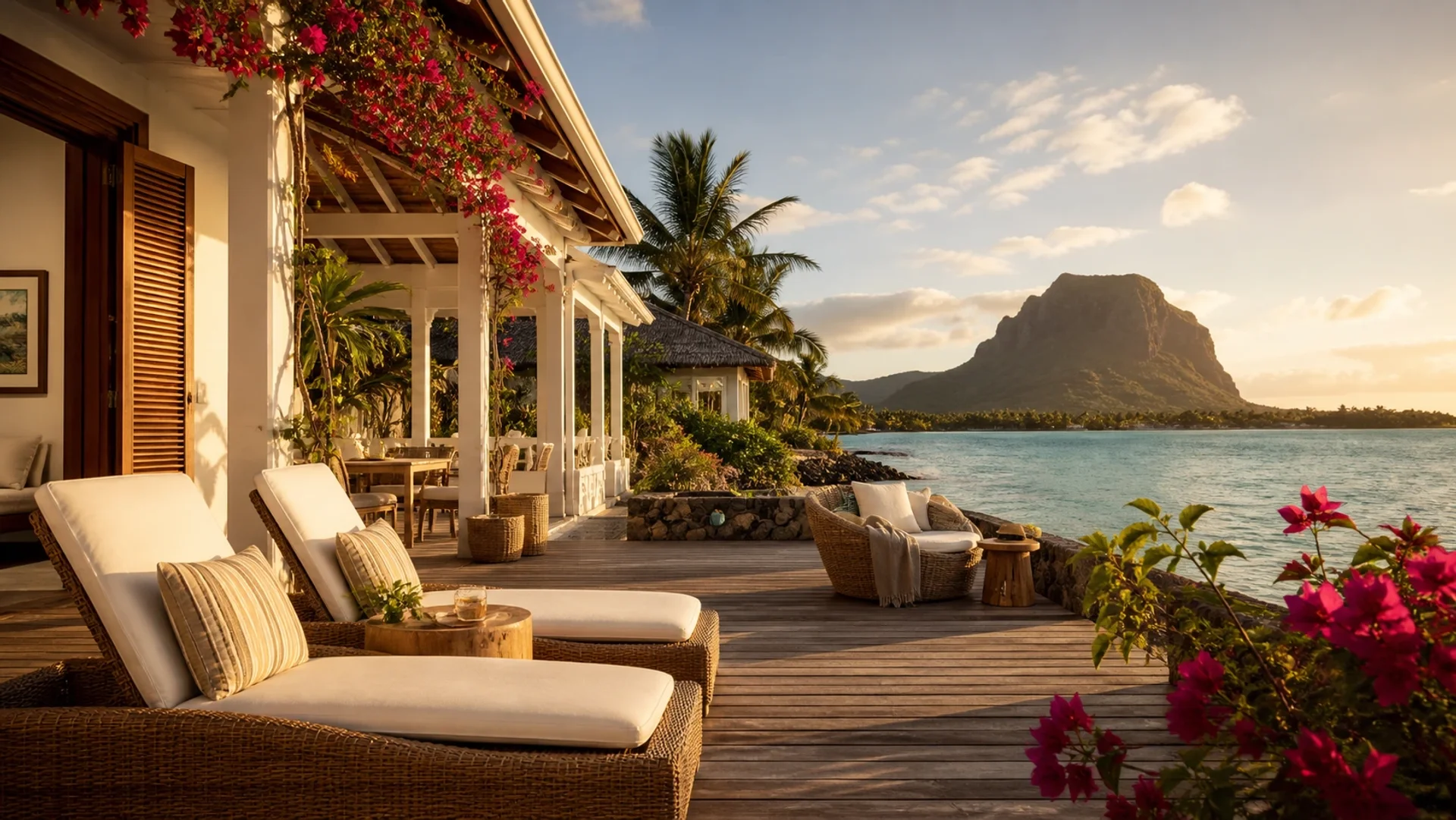
Mauritius · Indian Ocean
Custom Bali Furniture for Mauritius
Delivered door to door from our workshop in Kerobokan, Bali. 18 to 25 days transit.
Mauritius, Indian Ocean
The market
The Mauritius luxury hospitality market is well-established and mature. Constance, Beachcomber, LUX*, Sun Resorts, Maradiva, and Royal Palm dominate the upper segment with approximately 50 four-and-five-star properties on the island. The market specialises in destination-wedding tourism, MICE, and ultra-premium beachfront villas, particularly along the West and North coasts (Le Morne, Flic en Flac, Trou aux Biches, Grand Baie). Recent design specification has shifted toward more sustainable and natural materials, away from the synthetic finishes that defined Mauritian hospitality in the 2000s. Bali sources well into Mauritius because Indonesian teak handles cyclone-season conditions effectively.
Shipping & logistics
From Bali to Mauritius, the practical details.
- Transit time
- 18 to 25 days
- Departure port
- Benoa, Bali
- Arrival port
- Port Louis, Mauritius
- Standard incoterms
- CIF Port Louis
- Furniture import duty
- 0 to 15% depending on HS classification (most wood furniture is 0%, certain finished pieces may carry 15%)
- VAT / local tax
- 15% Mauritius VAT applies on duty-inclusive value
Direct and transshipment services from Benoa to Port Louis are available via Singapore or Cape routing. Port Louis is the primary container port on Mauritius and handles all major hospitality shipments. The Indian Ocean cyclone season (November to April) can occasionally delay shipments by 5 to 10 days, factor this into project timelines for properties commissioning during this window.
Customs & import notes
Mauritius applies customs duty rates from 0 to 100% across import categories, with most wood furniture HS codes carrying 0% duty under the country's tariff liberalisation commitments. Some finished furniture categories may carry 15% duty, this should be confirmed with a Mauritian customs broker before shipment. Standard 15% VAT applies on the duty-inclusive landed value. SVLK timber legality certificate required. Mauritius is a member of COMESA and SADC, but these agreements do not affect Indonesian imports directly.
Climate considerations
Tropical maritime, 20 to 30°C, with an Indian Ocean cyclone season November to April requiring storm-rated structural specifications.
- Tropical maritime climate, 20 to 30°C with Indian Ocean cyclone season November to April
- UV index 11 to 13 in summer, 7 to 9 in winter
- Cyclone-grade structural specifications required for outdoor furniture; flexible joinery (mortise and tenon) survives 200+ km/h winds where rigid construction fails
- Salt-air exposure on south and east coast properties is severe; west and north coasts (Le Morne, Trou aux Biches) have moderate exposure
Recommended materials for Mauritius
A-Grade Plantation Teak (cyclone-resistant outdoor)
Teak is the primary material for Mauritius outdoor furniture. The cyclone season (November to April) brings 200+ km/h winds and saline rain that destroy lesser timbers. A-grade plantation teak, properly secured, survives multiple cyclone seasons; flexible joinery (mortise and tenon with brass hardware) handles structural stress better than rigid construction. Pool decks, restaurant terraces, beach club furniture.
Reclaimed Teak (statement pieces, indoor)
Mauritian luxury hotels increasingly specify reclaimed teak for indoor statement pieces: lobby tables, restaurant communal tables, custom bar fronts. The material's heritage character aligns with the colonial-era architecture preserved on the island.
Volcanic Stone (Paras), indoor
Paras stone provides a complementary indoor material for Mauritian luxury interiors: statement dining tables, bathroom basins, reception desk elements. AC-conditioned environments suit the material well; direct outdoor sun exposure is not recommended in Mauritian summer.
Why Balinese furniture works for Mauritius
The case for Bali sourcing in the Mauritius market is partly operational and partly material. The Bali-to-Mauritius route, 18 to 25 days, is comparable to European alternatives but at significantly lower cost basis. Indonesian teak’s natural oil content handles the salt-and-cyclone environment of Mauritius effectively.
On material performance: Bali’s teak and reclaimed timber handle the high humidity (75 to 85% year-round) and intense UV without warping or bleaching, where European hardwoods often require chemical preservation. Mauritian resort design language has shifted toward natural materials over the past decade, aligning well with Bali’s craft output.
For projects commissioned during the November-April cyclone season, we recommend a 2 to 3 week buffer in the delivery timeline to absorb potential weather-driven delays in the Indian Ocean trade lane.
What a typical Mauritius hospitality project would include
A Mauritius hospitality project would typically take one of three shapes. A beachfront resort commission on the West, North, East, or South coast (Constance, Beachcomber, LUX*, Sun Resorts, Maradiva, or Royal Palm scale, often 80 to 200 keys) would usually involve repeated bedroom FF&E, restaurant and bar interiors, spa fit-outs, and pool-deck and beach-club pieces, with regional design language varying noticeably between the more animated North coast (Grand Baie, Trou aux Biches), the wilder East coast, the exclusive South (Le Morne, La Belle Mare), and the West (Flic en Flac). A villa commission within an Integrated Resort Scheme or Property Development Scheme estate (Anahita, Tamarina, Domaine de Bel Ombre) would typically scope to a single 20ft to 40ft container per villa, often coordinated through the estate’s design oversight team. Standalone boutique hotel commissions outside the resort and IRS/PDS frameworks are less common and tend to scale around 30 to 50 keys.
Furniture considerations for Mauritius climate
Engineer outdoor pieces to cyclone-grade structural specifications. The Indian Ocean cyclone season runs November to April with peak intensity in January and February, and Mauritius sits in the active cyclone belt. Mortise-and-tenon joinery with brass hardware, A-grade teak frames, and piece designs that flex rather than rigidly resist 200+ km/h winds survive multiple cyclone seasons; rigid construction and lower-grade timbers do not. This affects piece geometry as well as material choice, narrow legs and overhanging spans are the predictable failure points.
Differentiate spec by coast. Mauritius’ coastal environment is not uniform. The South and East coasts face the dominant SE trade winds and severe salt-air loading year-round, while the West and North (Le Morne, Flic en Flac, Trou aux Biches, Grand Baie) sit in moderate-exposure zones with sheltered lagoons. Marine-grade hardware and fully sealed timber are mandatory on the South and East; the West and North can take lighter specifications without compromising durability. Specify by coast at briefing stage.
Use the inland topography for the protected-storage chain. Curepipe, Floreal, and Black River sit far enough inland and at sufficient altitude to escape coastal salt-air loading, and many resort operators use inland warehousing as a pre-storm staging point for lighter outdoor pieces during cyclone watches. This is operationally relevant for any beach-resort project, the inland-to-coast transit window can be planned alongside delivery sequencing rather than discovered as an afterthought.
Buyer checklist for Mauritius projects
- Time outdoor installations outside the November-to-April cyclone season where the project schedule allows. May to October offers steadier conditions for pool-deck, beach-club, and exposed-terrace work.
- Plan a 2 to 3 week schedule buffer for projects commissioning during the cyclone window. Sea-freight delays of 5 to 10 days during major storm events are not uncommon and accumulate against hard opening dates.
- Confirm Port Louis clearance timing with your freight forwarder. The port handles all major hospitality cargo on the island, and slot pressure varies seasonally.
- For IRS or PDS villa projects, verify estate-specific documentation requirements with the development’s management team. Foreign-owner villa imports under IRS or PDS schemes typically carry administrative steps beyond standard customs clearance.
- Verify final-mile vehicle access for gated estates. Several IRS and PDS communities have access controls and dimensional restrictions that affect delivery vehicle choice.
- Confirm inland storage availability if the project involves cyclone-window delivery. Curepipe and Floreal warehousing options reduce post-arrival exposure for lighter outdoor pieces.
Questions about Mauritius delivery
How does cyclone season affect deliveries to Mauritius?
Cyclone season runs November to April. Indian Ocean shipping continues during this period but can experience 5 to 10 day delays during major storm events. We recommend commissioning resort projects with delivery dates outside the November to April window, or building 2 to 3 week buffer into project timelines if cyclone-season delivery is unavoidable.
Can teak handle the salt and UV exposure on Mauritian beaches?
Yes. A-grade plantation teak is among the few timbers that handles Mauritian beachfront conditions without chemical preservation. The material's natural silica and oil content provide 25 to 30 year structural performance with annual oil treatment. Untreated teak weathers to silver-grey within 18 months, which many Mauritian properties prefer aesthetically.
Do you ship FF&E for new resort developments on Mauritius?
Yes. Ubud Atelier handles full-property FF&E packages for Mauritian resorts, from 30-room boutique properties to 150-room mainstream resorts. Standard project flow is brief in week 1, design alignment in weeks 2 to 3, production in weeks 4 to 12, shipping in weeks 13 to 16, on-site delivery and assembly in weeks 17 to 18.
What documentation do you provide for Green Key or sustainability audits?
We provide FSC chain-of-custody certificates for plantation teak, zero-harvest declarations for reclaimed teak, SVLK Indonesian timber legality documentation, and material composition sheets for upholstery. Our documentation has been accepted by Green Key auditors for hospitality projects in similar markets.
Have a project in Mauritius?
Tell us your scope, timeline and destination. We confirm logistics and capacity within 48 hours.