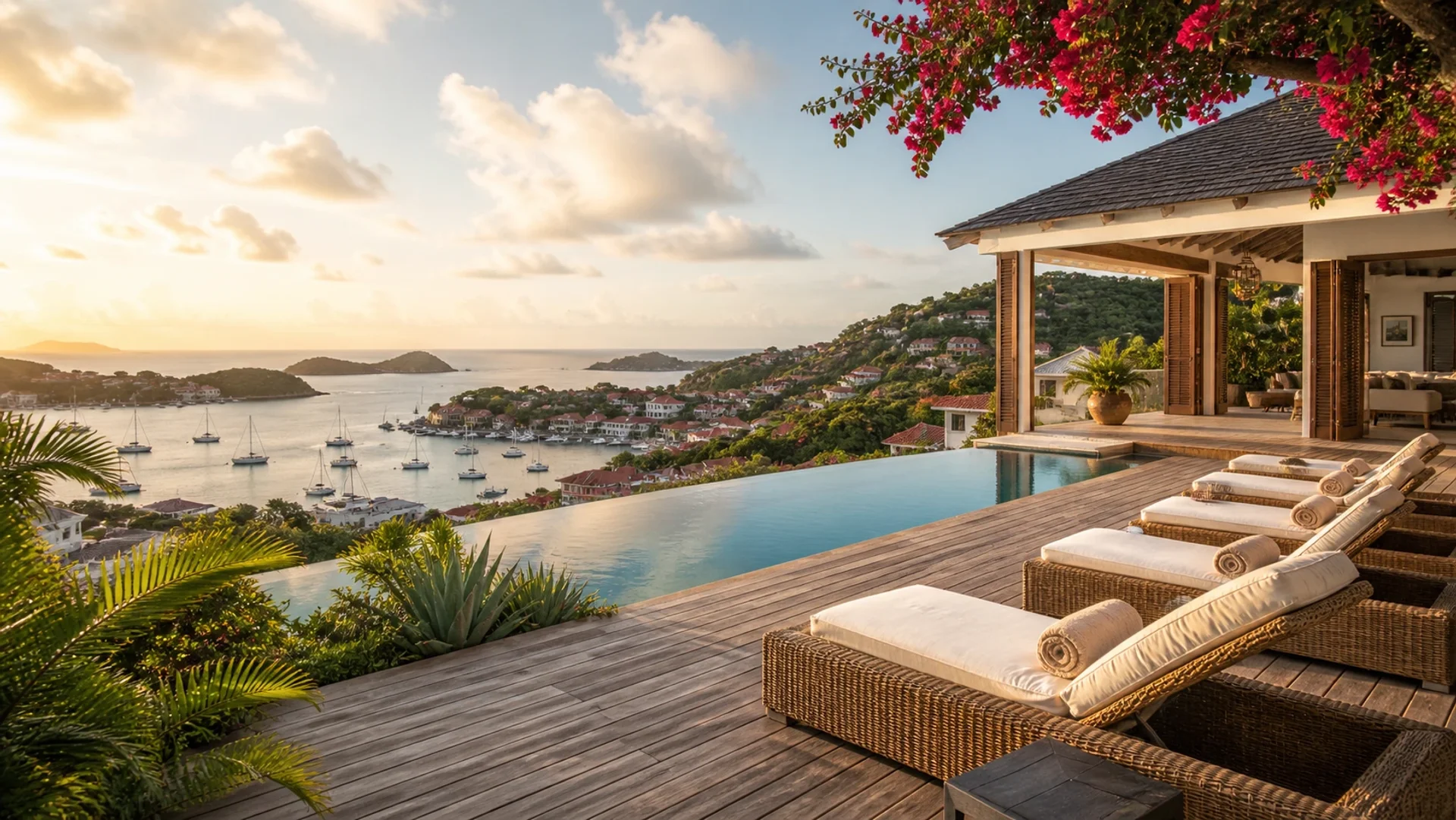
Saint Barthélemy · Caribbean
Custom Bali Furniture for Saint Barths
Delivered door to door from our workshop in Kerobokan, Bali. 35 to 45 days transit.
Saint Barthélemy, Caribbean
The market
Saint Barthélemy is among the world's most exclusive private villa markets. The 25-square-kilometer island has approximately 800 private villas (excluding hotels), with rental rates frequently exceeding $20,000 per week and sale prices above $20 million for premium beachfront properties. Hotels are limited and ultra-premium: Cheval Blanc, Le Toiny, Eden Rock, Rosewood Le Guanahani. The villa rental market drives most furniture procurement, with high-end interior designers (often Paris-based) specifying full FF&E for new builds and renovations every 5 to 10 years. The market is small but extraordinarily high-value, justifying long shipping routes and meticulous quality requirements.
Shipping & logistics
From Bali to Saint Barths, the practical details.
- Transit time
- 35 to 45 days
- Departure port
- Benoa, Bali
- Arrival port
- Gustavia (limited capacity) or Philipsburg, St Maarten
- Standard incoterms
- CIF Gustavia or CIF Philipsburg with door delivery
- Furniture import duty
- 0% (Saint Barths is a tax-free port for most imported goods)
- VAT / local tax
- 0% (Saint Barths has no VAT, unlike mainland France)
Saint Barths has unique tax status: as a French overseas collectivity that opted out of European Union customs jurisdiction in 2012, the island maintains tax-free port status with no customs duty and no VAT on most imported goods. The deep-water port at Gustavia has limited container capacity, so most full-container shipments transit through Philipsburg, Sint Maarten (40 nautical miles north), then transfer via inter-island barge.
Customs & import notes
Saint Barths' tax-free port status, established by the 2012 collectivity statute, eliminates customs duty and VAT on most imported goods including furniture. This is a significant cost advantage compared to nearby Caribbean destinations (Bahamas, St Vincent) where furniture import duty can reach 30 to 35%. However, the island operates a small contribution sociale on certain imports (typically around 4% of CIF value); confirm exact treatment with a Saint Barths customs broker. The Sint Maarten transit point may apply local fees during the inter-island transfer phase. SVLK timber legality certificate required for transit through Sint Maarten.
Climate considerations
Tropical, 25 to 30°C year-round, with Caribbean hurricane season June to November and constant trade winds.
- Tropical climate, 25 to 30°C year-round with Caribbean hurricane season June to November
- UV index 11 to 12 in summer; salt-air exposure on beachfront properties is moderate
- Hurricane-grade specifications required for outdoor furniture in direct exposure zones
- Trade winds provide consistent moderate breeze that accelerates patina development
Recommended materials for Saint Barths
A-Grade Plantation Teak (hurricane-rated outdoor)
Teak is the primary material for Saint Barths outdoor furniture. The Caribbean hurricane season tests furniture durability; A-grade teak with proper structural joinery survives Category 3 to 4 storms with minor cosmetic damage. Pool decks, beachfront terraces, restaurant outdoor seating. Annual teak oil application maintains the golden-brown finish; untreated teak weathers to silver-grey within 18 months.
Reclaimed Teak (statement pieces)
Saint Barths' design language often incorporates traditional French Caribbean elements with modern minimalism, where reclaimed teak's provenance story and visible character markings add depth. Lobby installations, dining tables, custom doors, feature walls.
Volcanic Stone (Paras), indoor
Paras stone for indoor villa applications: bathroom basins, statement dining tables, kitchen counters, reception desk elements. AC-conditioned environments suit the material well.
Why Balinese furniture works for Saint Barths
The case for Bali sourcing in Saint Barths combines unique tax efficiency and material performance for the Caribbean climate. The island’s tax-free port status means a $200,000 furniture order pays approximately $8,000 in contribution sociale (4% estimate), versus $70,000 or more in combined duty and VAT for the same shipment to the Bahamas or St Vincent.
The Bali-to-Saint Barths route, 35 to 45 days, is one of the longest in our network, but the destination value justifies the transit investment. On material performance: Indonesian teak handles Caribbean hurricane season (June to November) and salt-air conditions effectively, comparable to its performance in Indian Ocean and Pacific environments.
Most full-container shipments transit through Philipsburg, Sint Maarten, then transfer via inter-island barge to Gustavia, given Saint Barths’ limited deep-water port capacity. We coordinate the entire chain through our Caribbean logistics partners.
What a typical Saint Barths hospitality project would include
A Saint Barths hospitality project would typically be a private villa commission (3 to 8 bedrooms in Gouverneur, Lurin, Lorient, Pointe Milou, or Toiny), often coordinated by a Paris-based designer working through the local villa management company. Scope would usually involve indoor and outdoor dining, master and guest bedroom sets, pool-deck and terrace pieces, and occasional bathroom stone elements, fitting comfortably into a 20ft to 40ft container. Boutique hotel commissions concentrated around Gustavia and Anse des Cayes are smaller in number but typically larger in piece count per project, particularly for the few ultra-premium properties that anchor the island’s hotel segment.
Furniture considerations for Saint Barths climate
Specify lacquered brass over iron throughout, even on inland villas. Saint Barths is small and exposed enough that salt-laden trade winds reach almost every property, even those above the coast at Lurin or Lorient. Lacquered brass holds finish for years against the constant salt-air load; raw iron and lower-grade plated hardware corrode within 12 to 18 months. The cost difference at briefing stage is small; the cost of premature replacement on a renovated villa is not.
Plan outdoor pieces around hurricane-season anchoring, not aesthetic alone. The June-to-November Caribbean hurricane season, with peak intensity in August to October, regularly tests outdoor furniture on the island. Heavy teak frames or stone-base pieces that can be physically anchored to the deck are the durable specification for permanent terrace installations. Lighter outdoor pieces should be designed to be moved into indoor storage during named-storm watches.
Plan for moisture cycles, not constant humidity. Saint Barths’ year-round trade-wind exposure combines with seasonal humidity changes to drive expansion-and-contraction cycles in unsealed timber, the practical consequence is loosened joinery in the first 12 to 18 months on-island. Pre-shipping humidity cure (acclimatising teak in conditions matched to Caribbean targets before container loading) materially reduces these cycles’ impact.
Buyer checklist for Saint Barths projects
- Plan delivery windows around the hurricane season. June to November carries non-trivial schedule risk on the inter-island leg from Sint Maarten; for high-stakes openings, target a December-to-May arrival window where possible.
- Confirm Sint Maarten transhipment timing with your freight forwarder. Most full-container shipments transit Philipsburg before the inter-island barge to Gustavia, and the second leg’s frequency varies seasonally.
- Confirm villa access dimensions and slope before committing to large pieces. The hill villas of Lurin and Pointe Milou are reached via narrow, steep roads, larger pieces may require porter teams or smaller-vehicle final-mile delivery.
- Coordinate the Gustavia arrival window with your local logistics partner and villa management. Deep-water capacity at Gustavia is constrained, and delivery slots are best booked early.
- Specify whether outdoor pieces are permanent installations or seasonal pieces in the brief. This affects both anchoring specification and storage planning ahead of named-storm watches.
Questions about Saint Barths delivery
Does Saint Barths really have no customs duty or VAT on furniture?
Effectively, yes. Since the 2012 collectivity statute, Saint Barths operates as a tax-free port outside EU customs jurisdiction. Most imported goods including furniture are exempt from customs duty and VAT. A small contribution sociale (typically around 4% of CIF value) may apply to certain categories. This is in stark contrast to nearby Caribbean destinations where furniture import duty can reach 30 to 35%.
How does delivery to Saint Barths actually work, given the limited port?
Most full-container shipments transit through Philipsburg, Sint Maarten (40 nautical miles north of Saint Barths), then transfer via inter-island barge to Gustavia. Smaller mixed-load shipments can arrive directly at Gustavia. Total transit time including the inter-island transfer is 35 to 45 days from Benoa. Final delivery and assembly at the villa typically adds 2 to 5 days.
Can your furniture handle Caribbean hurricane season?
Yes. A-grade plantation teak with proper structural joinery (mortise and tenon, brass hardware) survives Category 3 to 4 hurricanes with minor cosmetic damage, where rigid construction or lesser timbers fail completely. We provide hurricane-rated specifications for villas in Caribbean exposure zones, including recommendations for pre-storm storage and post-storm refurbishment.
Do you work with French interior designers on Saint Barths projects?
Yes. Ubud Atelier works with Paris-based interior designers and architects managing villa renovations and new builds. We work with technical drawings (DWG, PDF) and material specifications in French or English, and provide CAD-ready content for designers' renderings. Sample dispatch to Paris is included for projects above €50,000.
Have a project in Saint Barths?
Tell us your scope, timeline and destination. We confirm logistics and capacity within 48 hours.