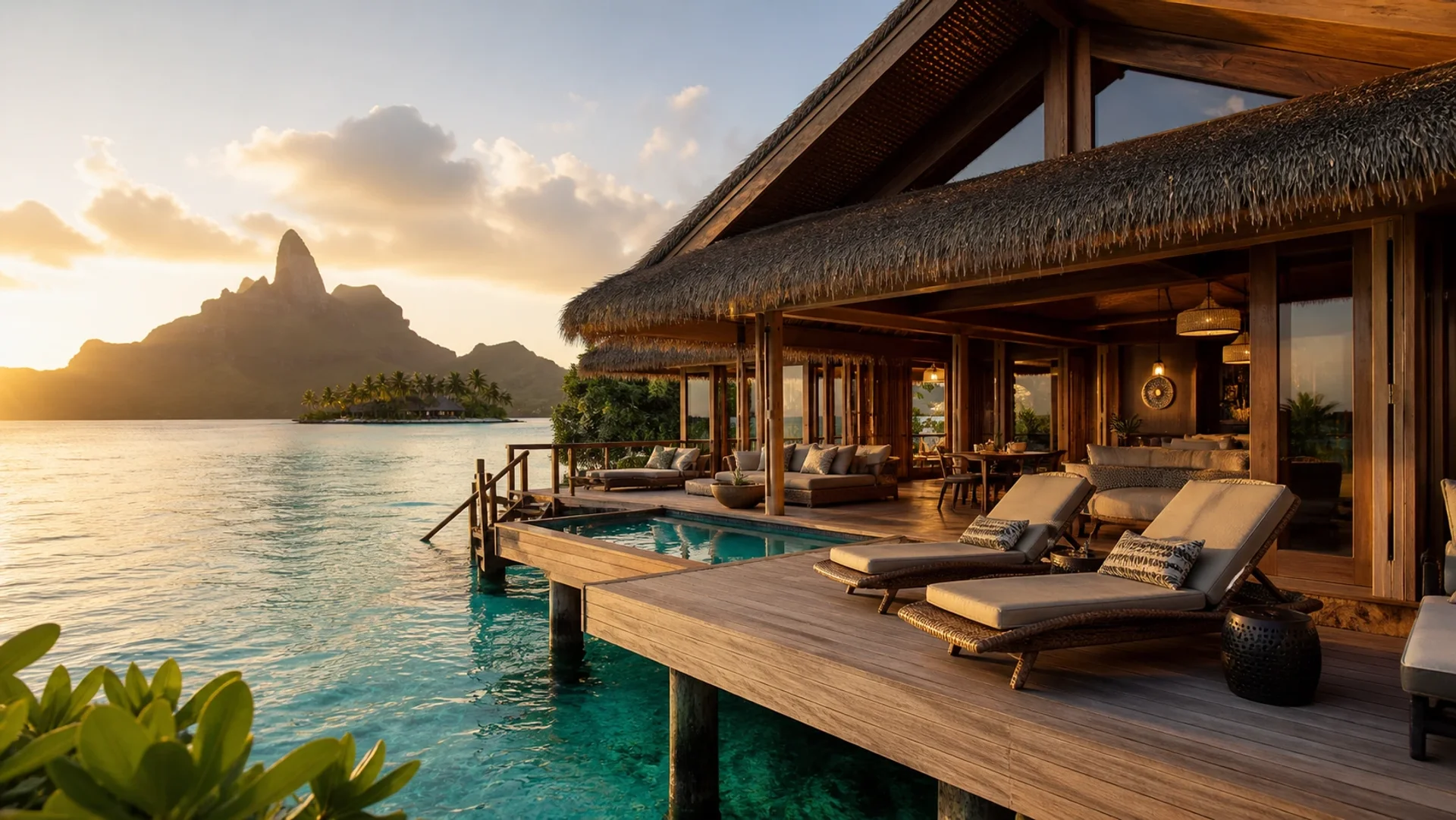
French Polynesia · Polynesia
Custom Bali Furniture for Tahiti & Bora Bora
Delivered door to door from our workshop in Kerobokan, Bali. 25 to 35 days transit.
French Polynesia, Polynesia
The market
French Polynesia's luxury hospitality market is concentrated on overwater villa properties, primarily in Bora Bora (Four Seasons, St Regis, Conrad, Intercontinental Thalasso) and increasingly on Moorea and Tahiti itself. Brando on Tetiaroa represents the ultra-premium private island segment. The 121-island archipelago hosts approximately 30 luxury resort properties with over-water villa inventory exceeding 600 keys total. Furniture specification for French Polynesian hospitality emphasises marine-grade materials given the constant salt-air, lagoon-water exposure, and direct sun. Bali sources well into French Polynesia's market because Indonesian teak meets the marine specifications natively.
Shipping & logistics
From Bali to Tahiti & Bora Bora, the practical details.
- Transit time
- 25 to 35 days
- Departure port
- Benoa, Bali
- Arrival port
- Papeete, Tahiti
- Standard incoterms
- CIF Papeete
- Furniture import duty
- 5-15% (EU TARIC)
- VAT / local tax
- 16% TVA Polynésienne applies on duty-inclusive value
Direct services from Benoa to Papeete are available via transshipment hubs (typically Auckland or Fiji). Papeete is French Polynesia's primary international port and handles all major hospitality cargo. From Papeete, inter-island shipping to Bora Bora, Moorea, and other Society Islands operates on weekly schedules; total transit including inter-island transfer adds 3 to 7 days to Bali-to-Papeete time. Pacific shipping routes are reliable but add transit time compared to Indian Ocean routes.
Customs & import notes
French Polynesia operates as a French overseas collectivity outside EU customs jurisdiction, with customs procedures aligned with EU TARIC for product classification. Furniture customs duty varies by HS code, typically 5 to 15%, with additional environmental levies on certain categories. Standard 16% TVA Polynésienne (local VAT) applies on the duty-inclusive landed value. SVLK Indonesian timber legality certificate required for wood products. Documentation must be in French; we work with experienced Papeete-based freight forwarders who manage the French-language customs declarations.
Climate considerations
Tropical, 24 to 30°C year-round, with Pacific cyclone risk November to April and continuous lagoon-water exposure on overwater villas.
- Tropical climate, 24 to 30°C year-round with Pacific cyclone risk November to April (lower frequency than Indian Ocean)
- UV index 11 to 13 year-round, exceptionally intense in austral summer
- Continuous lagoon-water and salt-spray exposure on overwater villa applications; marine-grade A-grade teak only
- Constant trade winds provide ventilation and accelerate natural drying
Recommended materials for Tahiti & Bora Bora
A-Grade Plantation Teak (full marine outdoor)
Teak is the primary material for French Polynesian overwater villa applications: deck flooring, outdoor furniture, structural elements exposed to constant lagoon water and salt air. The material's natural oil content provides 25 to 30 year structural integrity, making it the only practical timber choice for over-water villa contexts where replacement is operationally complex.
Natural Rattan (covered outdoor & indoor)
Rattan thrives in French Polynesian climate when kept under cover. Lounge chairs, hanging seats, partition screens for villa interiors and covered terraces. Avoid full direct sun in Polynesian summer where UV is exceptionally intense; covered verandas and shaded pavilions deliver 15 to 20 years of performance.
Reclaimed Teak (statement pieces)
Reclaimed teak's heritage character aligns with French Polynesian villa design language, where many properties incorporate traditional Polynesian craft elements. Statement dining tables, custom bar fronts, lobby feature walls.
Why Balinese furniture works for French Polynesia
The case for Bali sourcing in French Polynesia is partly aesthetic and partly material. The Bali-to-Papeete route, 25 to 35 days, is comparable to French or Asian alternatives but at significantly lower cost basis.
Indonesian teak’s natural silica and oil content handle the constant salt-air exposure of overwater villa environments where most other timbers require chemical preservation. The aesthetic alignment is also strong: French Polynesian resort design has converged on natural materials and indoor-outdoor living, the same design language Bali’s craft tradition produces.
For an over-water villa with continuous lagoon-water exposure, A-grade plantation teak provides 25 to 30 year structural performance where lesser timbers fail within 5 to 8 years. Final delivery to specific motu locations is coordinated with resort management for marine transit from Papeete.
What a typical French Polynesia hospitality project would include
A French Polynesia hospitality project would almost always be a resort commission, typically 50 to 100 keys mixing beach villas with over-water bungalows in the format the territory effectively defined for the global luxury market. Bora Bora anchors the segment (Four Seasons, St Regis, Conrad Bora Bora Nui, InterContinental Le Moana and Thalasso), with parallel ultra-luxury inventory on Mo’orea (Hilton, InterContinental, Sofitel) and Taha’a (Le Taha’a by Pearl Resorts), and the private-island segment at Tetiaroa (The Brando). Scope would typically include repeated bedroom FF&E across all keys with distinct specifications between beach and over-water types, restaurant and bar interiors, spa fit-outs, and pool-deck plus jetty pieces. Project containers commonly span 2 to 4 × 40ft HC for full-property fit-outs.
Furniture considerations for French Polynesia climate
Specify over-water bungalow pieces for continuous lagoon-water exposure, not just salt air. Over-water furniture lives suspended directly above the lagoon with continuous spray, mist, and reflective UV reaching the underside of every piece. A-grade plantation teak with marine-grade brass and fully sealed joinery is the practical default for over-water bungalows; mid-tier hardwoods and standard hardware fail within 5 to 8 years in this exposure profile. The specification gap between over-water and beach villa pieces is significant and should be locked at briefing stage.
Calibrate hurricane rating to the Polynesian risk profile, not the Caribbean one. French Polynesia sits in a historically lower-frequency cyclone zone than the Atlantic Caribbean or the Mascarene Islands, so the structural over-engineering required for properties in Mauritius or Saint Barths is not the operative reference. Marine-grade specification remains mandatory; Category 5 hurricane-grade structural rating is generally not. This is a real cost and design economy worth recognising on Polynesian projects.
Plan finishes for sustained Pacific UV. UV index 11 to 13 year-round, peaking in austral summer (December to February), drives finish degradation at the upper end of the workshop’s destination network. Untreated rattan and unsealed natural fibres lose colour and integrity in 12 to 18 months under direct exposure; UV-stabilised treatments and shaded placement protocols are paired specifications rather than independent choices.
Buyer checklist for French Polynesia projects
- Plan inter-island barge timing from Papeete to the destination atoll. Mo’orea is reachable in hours; Bora Bora and Taha’a typically run 1 to 2 days on barge depending on schedule. This affects sequencing of hard installation dates.
- Coordinate with Papeete-based freight forwarders experienced in French-language customs declarations. French Polynesia operates as a French overseas collectivity with its own customs and fiscal procedures, defer to the broker on specifics rather than assuming Metropolitan French rules apply.
- Target the May-to-October dry season for over-water bungalow installation work where the schedule allows. Calmer lagoon conditions and lower rainfall make jetty offloads and over-water placements materially easier.
- Confirm jetty width, lagoon depth at the destination motu, and barge size compatibility before scoping over-water bungalow piece dimensions. Final-mile placement on motu locations is often the binding constraint rather than the production specification.
- Differentiate over-water bungalow and beach villa specifications in the brief at the start. The two types have distinct hardware, joinery, and finish requirements, and consolidating production to common drawings is a recurring source of mid-project rework.
Questions about Tahiti & Bora Bora delivery
How does delivery to Bora Bora actually work?
Container shipments arrive at Papeete, Tahiti (25 to 35 days from Benoa). From Papeete, inter-island shipping to Bora Bora operates on weekly schedules via inter-island freight vessels, adding 3 to 7 days. Final delivery to specific overwater villa properties typically requires coordination with resort management for marine transit to motu locations. Total door-to-door timing is 16 to 20 weeks from order confirmation.
Can your furniture handle continuous overwater villa exposure?
Yes, with marine-grade specifications. A-grade plantation teak's natural oil content provides structural performance in continuous salt-water and salt-air exposure for 25 to 30 years. We provide marine-grade certifications and recommend specific teak oil maintenance protocols for over-water villa applications. This is one of the demanding use cases our material handles well, where European hardwoods or treated softwoods fail within 5 to 8 years.
Do you handle French-language documentation for Polynesian customs?
Yes. We work with Papeete-based freight forwarders who manage customs declarations in French. Standard documentation includes Commercial Invoice, Packing List, Bill of Lading, Certificate of Origin, SVLK timber legality certificate, and Phytosanitary Certificate for natural fibres. We provide content in both English and French as required by French Polynesian customs.
What's the typical project scope for a Bora Bora resort?
Most Bora Bora resort projects we ship are FF&E packages for properties with 30 to 100 over-water villas, representing 150 to 500 furniture pieces per project. Project values typically range €100,000 to €400,000 ex-works depending on scope and customisation. Smaller villa-by-villa renovations are also welcome; the economics work above 40 to 50 piece minimum order.
Have a project in Tahiti & Bora Bora?
Tell us your scope, timeline and destination. We confirm logistics and capacity within 48 hours.