Italy · Mediterranean
Custom Bali Furniture for Sicily
Delivered door to door from our workshop in Kerobokan, Bali. 25 to 35 days transit.
Italy, Mediterranean
The market
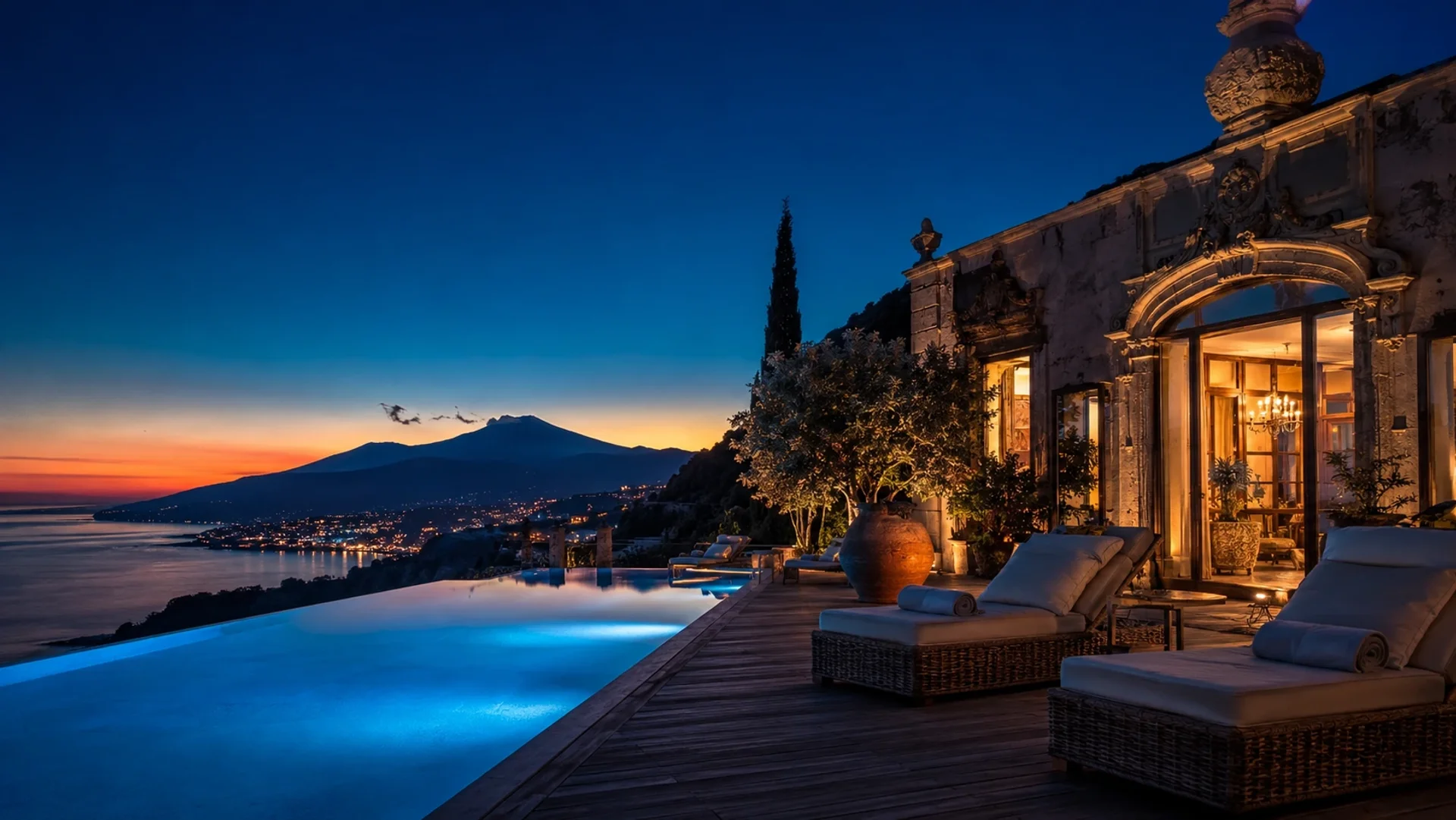
Sicily's luxury hospitality market spans the eastern coast (Taormina, Catania, Syracuse, Noto), the western coast (Palermo, San Vito Lo Capo, Trapani), and the Aeolian Islands (Lipari, Salina, Panarea, Stromboli). The 25,000-square-kilometer island hosts approximately 35 luxury hotel properties, including Belmond Grand Hotel Timeo, Four Seasons San Domenico Palace Taormina, Verdura Resort, and the iconic boutique resorts of the Aeolian Islands. Recent expansion has been driven by the post-pandemic Mediterranean luxury boom and the international success of "The White Lotus" Season 2 (filmed at San Domenico) which dramatically elevated Taormina's global hospitality profile. The villa rental market has grown significantly, with Noto, Modica, and Aeolian Islands emerging as boutique villa hubs.
Shipping & logistics
From Bali to Sicily, the practical details.
- Transit time
- 25 to 35 days
- Departure port
- Benoa, Bali
- Arrival port
- Palermo or Catania, with inter-island ferry to Aeolian Islands if applicable
- Standard incoterms
- CIF Palermo or CIF Catania
- Furniture import duty
- 0% under EU GSP+ (Indonesia is GSP+ beneficiary) for most wood furniture HS codes, estimate to confirm by HS classification
- VAT / local tax
- 22% Italian IVA applies on duty-inclusive value
Direct services from Benoa to Sicilian ports operate via Suez Canal routing through Genoa or Civitavecchia, then inter-island feeder vessel to Palermo or Catania (3 to 5 days additional). Total Bali-to-Sicily transit is 28 to 40 days. Catania serves the eastern coast (Taormina, Syracuse, Noto) more efficiently; Palermo serves the western coast (Cefalù, San Vito Lo Capo) and Aeolian Islands. Final-mile delivery to Aeolian Islands requires inter-island ferry (Lipari from Milazzo, 1 hour) plus on-island delivery.
Customs & import notes
Italy operates as an EU member state, so EU customs procedures apply. The EU's GSP+ status with Indonesia provides 0% customs duty on most wood furniture HS codes (estimate to confirm by HS classification); some specific categories may carry residual duties under standard EU TARIC. Standard 22% Italian IVA applies on the duty-inclusive landed value. SVLK Indonesian timber legality certificate is required and is recognized by EU customs as compliant with EUTR. Sicilian customs procedures align with mainland Italy; we coordinate with experienced Catania-based brokers for eastern coast destinations and Palermo-based brokers for western coast and Aeolian Islands.
Climate considerations
Mediterranean with subtropical influences. Hot dry summers reach 35 to 40°C in inland areas; salt-air exposure on the direct coast is moderate to high.
- Mediterranean with subtropical influences, hot dry summers reaching 35 to 40°C in inland areas
- UV index 10 to 11 in summer, 5 to 7 in winter
- Salt-air exposure on direct coast (Taormina, San Vito Lo Capo) is moderate to high
- Aeolian Islands face additional volcanic ash exposure during Stromboli eruption events, minimal impact on hospitality furniture but may affect cleaning frequencies
Recommended materials for Sicily
A-Grade Plantation Teak (Mediterranean outdoor)
Teak performs excellently in Sicilian conditions. The intense summer UV (10 to 11 index in July to August around Catania), salt-air exposure on coastal properties, and dry summer heat are handled by teak's natural oil content without chemical preservation. Pool decks, terrace dining, beach club furniture along the eastern coast. Annual teak oil maintains the golden-brown finish; many Sicilian properties prefer the silver-grey weathered patina that develops within 18 months.
Reclaimed Teak (statement pieces)
Reclaimed teak's heritage character aligns deeply with Sicilian baroque architectural traditions, where authentic age and material provenance are valued. Statement dining tables, custom bar fronts, lobby feature walls for boutique hotel renovations and villa projects in Noto, Modica, and Taormina.
Natural Rattan (covered outdoor & indoor)
Rattan suits Sicilian covered terrace and indoor applications well. Particularly relevant for the Aeolian Islands' white minimalist aesthetic where natural fibres add warmth without competing with the architectural simplicity. Lounge seating, partition screens, hanging chairs in shaded courtyards and ground-floor terraces.
Why Balinese furniture works for Sicily
Sicilian luxury hospitality has settled on a layered material vocabulary that draws from the island’s own deep traditions, Etna lava stone, traditional Caltagirone ceramics, baroque carved detail from Noto and Modica, wrought iron, noble timber, set against the backdrop of intense Mediterranean sun and coastal salt exposure. Bali’s craft tradition produces pieces aligned with that vocabulary, hand-carved teak, woven natural fibres, sealed structural joinery, at hospitality scale that local Sicilian artisan workshops cannot match.
The operational case sits alongside the aesthetic. A Sicilian hospitality project would typically need to coordinate Italian contract furniture production (Cassina, Molteni, Poliform contract divisions, premium-priced and largely catalogue-fixed) with limited-volume local artisan supply. A single Bali workshop with full-scope custom capability eliminates that multi-source coordination, delivers piece-to-piece consistency that catalogue procurement rarely matches, and offers customisation depth on the Mediterranean material palette (carved hardwoods, stone-detail finishes, woven rattan) that factory production does not. After Mediterranean transit, the proposition remains competitive against Italian contract alternatives once customisation depth is factored in.
What a typical Sicily hospitality project would include
Sicily projects span three logistically distinct sub-markets. A Taormina or Cefalù boutique hotel (40 to 80 keys) would typically involve bedroom FF&E, restaurant fit-outs, and terrace furniture serving sea-view dining. An Aeolian Islands boutique commission in Stromboli, Salina, or Panarea (20 to 30 keys) would typically be smaller in piece count but with stricter dimensional and weight constraints due to ferry handling. A Marsala or Noto countryside villa (4 to 10 bedrooms) would include indoor dining, lounge, bedrooms, and outdoor terrace pieces in a single 20ft to 40ft container, with simpler logistics than the island commissions.
Furniture considerations for Sicily climate
Build for sustained extreme heat, not just peak UV. Sicily’s interior, including parts of Marsala, Noto, and the southern coast, regularly exceeds 38°C during July and August heatwaves, with night-time temperatures staying above 28°C. Specify high-density heat-stable foams, avoid wax-based interior finishes, and ensure timber moisture content is calibrated to dry conditions, not tropical norms.
Plan for volcanic ash settlement on Aeolian properties. Properties on Stromboli, Salina, and Panarea live with intermittent fine ash from active and dormant volcanic systems. Smooth, easily wiped finishes outperform high-relief surface textures, deeply textured upholstery and carved relief panels accumulate ash that is difficult to fully remove. Natural matte finishes hide trace residue better than high-gloss.
Treat coastal teak conservatively. Sicily’s combined high UV and moderate-to-high salt exposure on direct-coast properties (Taormina marina, San Vito Lo Capo, eastern Aeolians) is more punishing than the Costa Smeralda equivalent. Use A-grade plantation teak with annual oil maintenance for any exposed pool-deck or terrace dining piece, reclaimed teak with a softer grain density should be reserved for shaded or indoor settings.
Buyer checklist for Sicily projects
- Choose Palermo or Catania container arrival based on the final destination. Catania serves Taormina, Syracuse, and Noto more efficiently; Palermo serves Cefalù, San Vito Lo Capo, and the Aeolian ferry to Milazzo.
- For Aeolian projects, factor in winter ferry cancellations. Storm-driven cancellations between November and March are not unusual and can extend final-mile delivery by 1 to 2 weeks. Avoid hard opening dates in the December to February window.
- Confirm whether your final-mile freight forwarder has handled inter-island ferry cargo before. The additional handling step (Milazzo to Lipari, then island-to-island) is a specialist competence, not standard mainland Italian logistics.
- Include volcanic dust in the maintenance scope for Aeolian deliveries. The cleaning frequency required is materially higher than mainland properties, and onboarding the property’s housekeeping team on safe cleaning methods for the supplied finishes pays back quickly.
- For mainland Sicily, allow extra time during August. The ferragosto holiday period materially slows commercial road freight across the island.
Questions about Sicily delivery
How does delivery to the Aeolian Islands work?
Containers arrive at Palermo (25 to 35 days from Benoa), then transit via inter-island ferry to Lipari from Milazzo (Sicilian mainland, 1 hour ferry), then island-to-island ferry for Salina, Panarea, or Stromboli (additional 1 to 3 hours per island). Total Bali-to-Aeolian transit is 30 to 40 days. We coordinate with Sicilian ferry-experienced freight forwarders for these routes.
Are EU customs duties really 0% for furniture from Bali to Italy?
For most wood furniture HS codes, yes, under the EU's GSP+ status with Indonesia (estimate to confirm by HS classification). Some specific categories may carry residual duties of 2.7 to 5.6% under standard EU TARIC. The dominant cost is the 22% Italian IVA on the duty-inclusive landed value, which is the highest VAT rate among our European destinations.
Can your furniture handle Sicily's summer heat (often above 35°C)?
Yes. Sicilian summer temperatures (35 to 40°C peak) are within the comfort zone for A-grade plantation teak. Indonesian conditions regularly exceed these temperatures. The material's natural properties handle thermal expansion without warping. Salt-air exposure on coastal properties is moderate compared to ocean-facing tropical destinations.
Do you work with Italian interior designers managing Sicily projects?
Yes. Ubud Atelier works with Milan-based, Rome-based and local Sicilian interior designers and architects managing villa renovations and boutique hotel projects (particularly post-White Lotus boutique hotel boom). We work with technical drawings (DWG, PDF) in metric measurements, provide material specifications in English with Italian translations available, and dispatch material samples to Italian design studios for projects above €50,000.
Have a project in Sicily?
Tell us your scope, timeline and destination. We confirm logistics and capacity within 48 hours.