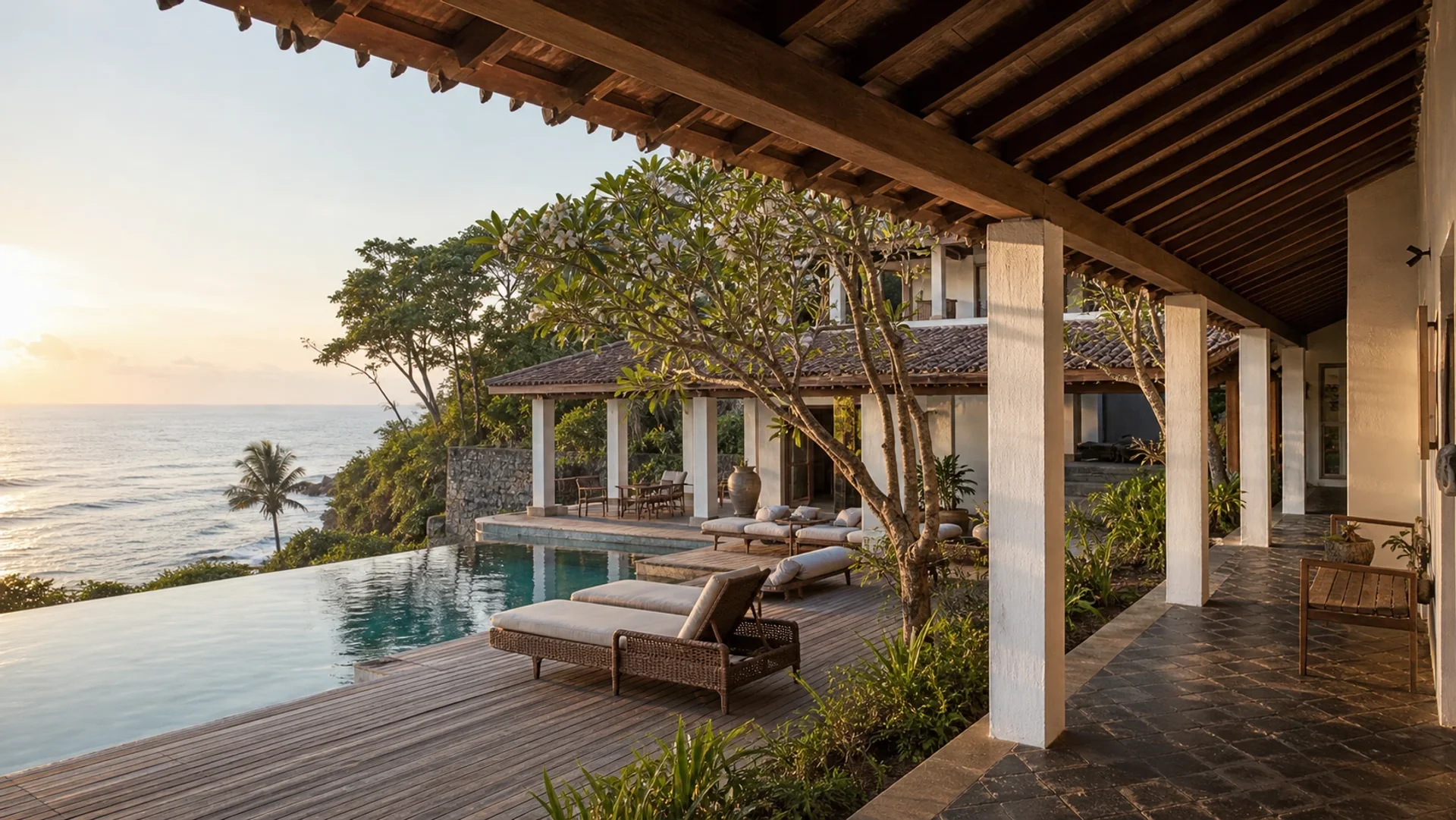
Sri Lanka · South Asia
Custom Bali Furniture for Sri Lanka
Delivered door to door from our workshop in Kerobokan, Bali. 7 to 12 days transit.
Sri Lanka, South Asia
The market
Sri Lanka's luxury hospitality market is in active growth. The post-2022 economic recovery has accelerated boutique resort development, particularly along the southern coast (Galle, Tangalle, Mirissa, Weligama) and the cultural triangle (Sigiriya, Dambulla). Aman Resorts, Cape Weligama, Anantara, and Shangri-La operate flagships; new boutique villa developments are emerging at the 8 to 30 key range, often by international designers with Sri Lankan partners. The country's design heritage (Geoffrey Bawa tropical modernism) creates strong alignment with Bali's craft output, both traditions emphasise natural materials, indoor-outdoor flow, and locally-rooted aesthetic.
Shipping & logistics
From Bali to Sri Lanka, the practical details.
- Transit time
- 7 to 12 days
- Departure port
- Benoa, Bali
- Arrival port
- Colombo Port, Sri Lanka
- Standard incoterms
- CIF Colombo
- Furniture import duty
- 5-15% (HS-dependent)
- VAT / local tax
- 18% Sri Lanka VAT applies on duty-inclusive value
Direct services from Benoa to Colombo are available across major carrier networks. Colombo Port is one of South Asia's primary container hubs and handles efficient processing for hospitality cargo. From Colombo, road transit to southern coastal destinations (Galle, Tangalle, Mirissa) is 2 to 4 hours; cultural triangle destinations (Sigiriya area) require 4 to 5 hours of road transit.
Customs & import notes
Sri Lanka customs duty for furniture varies by HS classification, typically 5 to 15%. The country has a complex tariff structure with multiple supplemental charges (Port and Airport Levy, Cess, Social Security Contribution Levy). The combined effective rate often exceeds the headline customs duty. Standard 18% VAT applies on the duty-inclusive landed value. SVLK Indonesian timber legality certificate is required for wood products. We work with experienced Colombo-based freight forwarders who manage the multi-charge customs structure efficiently.
Climate considerations
Tropical, two monsoon systems and high year-round humidity. Indonesian and Sri Lankan tropical climates are nearly identical.
- Tropical climate with two monsoon systems (Yala May to Sep affects southwest, Maha Dec to Feb affects northeast)
- UV index 10 to 12 year-round; humidity 75 to 85%
- Coastal salt-air exposure is moderate; well-cured Indonesian teak handles it without chemical preservation
- Cultural triangle inland (Sigiriya, Dambulla) has lower humidity and higher temperature variation
Recommended materials for Sri Lanka
A-Grade Plantation Teak (full outdoor)
Teak performs identically in Sri Lankan and Indonesian conditions. The southern coast (Galle, Tangalle, Mirissa) faces direct ocean exposure with intense monsoon rain (May to September) and high humidity year-round. Teak handles this without chemical preservation. Pool decks, beachfront loungers, restaurant terraces, all standard outdoor applications.
Reclaimed Teak (statement pieces)
The aesthetic alignment with Sri Lankan colonial heritage is strong. Galle Fort architecture (Dutch and Portuguese colonial) features 19th-century timber that resonates with reclaimed teak's provenance story. Statement dining tables, custom doors, lobby installations, feature walls.
Natural Rattan (covered outdoor & indoor)
Rattan thrives in Sri Lankan conditions when kept under cover. Verandas, breakfast pavilions, lounge seating. The country has its own rattan craft traditions, but our Indonesian sources can deliver larger volumes and consistent quality for hotel-scale projects.
Why Balinese furniture works for Sri Lanka
The case for Bali sourcing in the Sri Lanka market combines aesthetic affinity, transit speed, and material performance. The Bali-to-Sri Lanka route, 7 to 12 days transit, is among the fastest in our network. Sri Lankan resort design heritage, the Geoffrey Bawa tropical modernist tradition, emphasises the same materials we work with: teak, stone, natural fibres, indoor-outdoor flow.
Indonesian and Sri Lankan tropical climates are nearly identical, so material performance translates directly. For boutique resort developers seeking authentic craft at scale, Bali’s workshops deliver capacity that Sri Lankan local artisans, while excellent in quality, cannot match in volume for full FF&E projects.
The country’s customs structure includes multiple supplemental charges beyond headline duty (Port and Airport Levy, Cess, Social Security Contribution Levy). Our Colombo-based freight partner handles the multi-charge clearance and provides upfront landed cost calculations before each shipment.
What a typical Sri Lanka hospitality project would include
A Sri Lanka hospitality project would typically take one of three shapes. A southern coast beachfront resort commission (40 to 60 keys at the Cape Weligama, Wild Coast Tented Lodge, Anantara, Amanwella, or Shangri-La scale) would usually involve repeated bedroom FF&E, restaurant and bar fit-outs, and pool-deck and beach pieces, with marine-grade specifications for direct ocean exposure. A heritage boutique commission in Galle Fort (10 to 25 keys at the Amangalla scale or independent townhouse conversions) would carry tighter conservation constraints and tend to scope a smaller container (20ft) per project. A hill-country tea-estate property (Ella, Hatton, Nuwara Eliya, Ceylon Tea Trails scale, 10 to 30 keys) would specify a distinct material palette aligned to the cool-temperate cloud-forest setting rather than the tropical-coast vocabulary.
Furniture considerations for Sri Lanka climate
Calibrate joinery and finishes to Bawa-tradition indoor-outdoor architecture. Sri Lankan tropical modernism, the Geoffrey Bawa lineage that shapes most upper-segment resort design, prioritises pavilion architecture with extensive open-plan transitions between interior and exterior. Pieces are commonly specified to cross those transitions seamlessly, structural teak frames, sealed joinery, and finishes that hold up to ambient outdoor exposure even on nominally interior pieces. Marine-grade hardware on pieces in semi-outdoor pavilions is durable specification rather than over-engineering.
Engineer hill-country pieces for cool-temperate cloud-forest humidity, not tropical-coast specifications. The hill-country resort belt (Ella, Hatton, Nuwara Eliya) sits at altitude with materially cooler temperatures, persistent cloud-forest humidity, and elevated mold pressure that the tropical-coast properties do not face. Sealed joinery and humidity-stable finishes are critical at altitude; tropical-coast specifications calibrated to direct UV and salt loading are over-specified for the hill country and may carry the wrong finish for the climate.
Differentiate southwest and northeast monsoon scheduling per coast. Sri Lanka’s twin-monsoon system splits the country into two distinct rain calendars, the Yala (May to September) affects the southern and western coasts; the Maha (December to February) affects the eastern coast. Outdoor installation work for southern-coast resorts should target October to April; eastern-coast projects (Trincomalee, Pasikuda) should target March to November. Hill country sits in a transition zone with smaller monsoon impact.
Buyer checklist for Sri Lanka projects
- Coordinate Colombo Port clearance with your freight forwarder. Colombo is the country’s primary container hub and offers efficient processing for hospitality cargo.
- Plan road-haul timing from Colombo based on destination. Southern coast (Galle, Tangalle) is approximately 3 hours via the southern expressway; hill country (Hatton, Ella) is 5 to 6 hours via mountain roads; northeast (Trincomalee) is 7 to 8 hours.
- Match installation timing to the monsoon calendar of the destination coast. Southern projects target October to April; eastern projects target March to November. Hill country has smaller monsoon impact and offers wider scheduling latitude.
- For Galle Fort heritage projects, verify Department of Archaeology conservation rules before committing to any visible material spec on listed buildings. Conservation review may add weeks to project timing.
- For hill-country tea-estate properties, plan piece dimensions and access carefully. Mountain road approaches carry dimensional constraints that may require smaller-vehicle final-mile delivery.
Questions about Sri Lanka delivery
How does Sri Lanka's monsoon season affect deliveries?
Two monsoon seasons affect Sri Lanka: the Yala (Southwest) monsoon May to September affects the southern and western coasts, and the Maha (Northeast) monsoon December to February affects the eastern coast. Shipping continues year-round but inland delivery to coastal properties may experience 1 to 2 day delays during peak monsoon. We factor this into project timelines.
Can you handle the Sri Lankan customs supplemental charges?
Yes. Sri Lanka customs has multiple supplemental charges beyond standard customs duty (Port and Airport Levy, Cess, Social Security Contribution Levy). We work with experienced Colombo freight forwarders who handle the multi-charge structure and provide upfront landed cost calculations before shipment.
Do you work with Geoffrey Bawa style boutique projects?
Yes. Sri Lankan tropical modernism (Bawa school) and Balinese craft traditions are highly compatible aesthetically. Our material palette (teak, stone, rattan) and joinery techniques (mortise and tenon, exposed joinery) align directly with Bawa-influenced design language. We've supplied furniture to multiple Bawa-derivative properties on Sri Lanka's southern coast.
What is the typical project timeline for a Sri Lankan boutique resort?
14 to 18 weeks total from brief to on-site delivery. Production takes 8 to 10 weeks in our Bali workshop, sea transit Benoa to Colombo is 7 to 12 days, customs clearance 2 to 4 days, road transit and on-site assembly 5 to 10 days. Multi-property orders benefit from container consolidation.
Have a project in Sri Lanka?
Tell us your scope, timeline and destination. We confirm logistics and capacity within 48 hours.