Greece · Mediterranean
Custom Bali Furniture for Mykonos
Produced in the workshop in Kerobokan, Bali, and shipped door to door by the workshop and its freight forwarders. Typical ocean transit of 22 to 28 days.
Greece, Mediterranean
The market
Mykonos operates at the premium end of the Mediterranean hotel market, a 15 km island with some of the highest average room rates in Europe and a buyer profile that demands furniture of verifiable quality. The island's boutique hotel stock has undergone substantial renovation since 2018, with owners increasingly replacing mass-produced contract furniture with bespoke pieces that withstand scrutiny at close range. Teak and stone are the materials of choice: they age visibly and gracefully in the Aegean sun, and they communicate provenance in a way that powder-coated aluminium does not.
Shipping & logistics
From Bali to Mykonos, the practical details.
- Typical transit time
- 22 to 28 days
- Departure port
- Benoa, Bali
- Arrival port
- Port of Piraeus, Athens
- Standard incoterms
- CIF Piraeus
- Furniture import duty
- 0% on most solid wood furniture (standard EU rates); rattan and bamboo categories up to 5.6%, confirmed by HS classification before shipment
- VAT / local tax
- 24% Greek VAT applies on duty-inclusive value
Standard routing via Singapore or Port Klang, through the Suez Canal, to Piraeus. After customs clearance at Piraeus, furniture is trucked to the port of Rafina or Lavrio (50 to 80 km from Piraeus) and transferred by ferry to Mykonos. Mykonos has a small commercial port, large containers are split to smaller vehicles for final delivery. The freight forwarder at Piraeus handles this.
Customs & import notes
Furniture imported from Indonesia enters the EU at standard EU rates determined by HS classification. Most solid wood furniture under chapter 94 (HS 9403.60 and neighbouring lines) enters at 0% duty; rattan and bamboo categories (HS 9403.82, 9403.83) can carry up to 5.6%. HS classification is confirmed before each shipment. The EU-Indonesia trade agreement (CEPA) is expected to remove remaining duties on Indonesian furniture once in force; the agreement was concluded in September 2025 and is not yet signed, and its entry into force is targeted for January 1, 2027. Wooden furniture from Indonesia needs a FLEGT licence, issued on the Indonesian SVLK timber legality system; rattan and bamboo pieces are outside the scheme. From December 30, 2026, the EU Deforestation Regulation also applies to wooden furniture: the operator placing it on the EU market files a due diligence statement with the geolocation of the plots where the wood grew. Greek customs clearance at Piraeus typically takes 3 to 7 working days. Import broker fees apply.
Climate considerations
Mediterranean, hot, dry summers; mild, wet winters. Strong seasonal winds (meltemi). Salt air from May to October at all coastal properties.
- Meltemi winds (July to August) reach 7 to 8 Beaufort, outdoor furniture must be secured or moved during peak wind periods
- UV index 9 to 10 in summer; strong enough to bleach rattan without UV coating, typically within 2 seasons
- Salt air at all coastal properties; stone and teak handle this well, rattan needs UV-coating
- Winter rainfall and temperature fluctuations, outdoor furniture should be stored or covered November to March
Recommended materials for Mykonos
A-Grade Teak (outdoor)
A-grade teak ages exceptionally well in the Mediterranean climate. The Aegean sun weathers teak to a pale silver-grey that complements whitewashed Cycladic architecture naturally. For clients who prefer to maintain the warm tone, annual oiling is straightforward. Teak's natural silica resists the alkaline dust common in the Cyclades.
Volcanic Stone (Paras)
Paras stone's pale grey-beige tone reads almost Cycladic, it fits the local palette without visual conflict. Hand-carved stone basins and side tables are among the most requested pieces from Mykonos-bound clients. Stone stands up well to meltemi winds and sea salt.
Solid Brass Hardware (lacquered)
Brushed or raw brass with clear lacquer coating is appropriate for Mykonos properties. Without lacquer, bare brass will patinate in salt air, which some clients prefer aesthetically. Specify the finish intent at briefing stage. Marine-grade alloy is recommended for pieces directly exposed to sea air.
Why Balinese furniture works for Mykonos
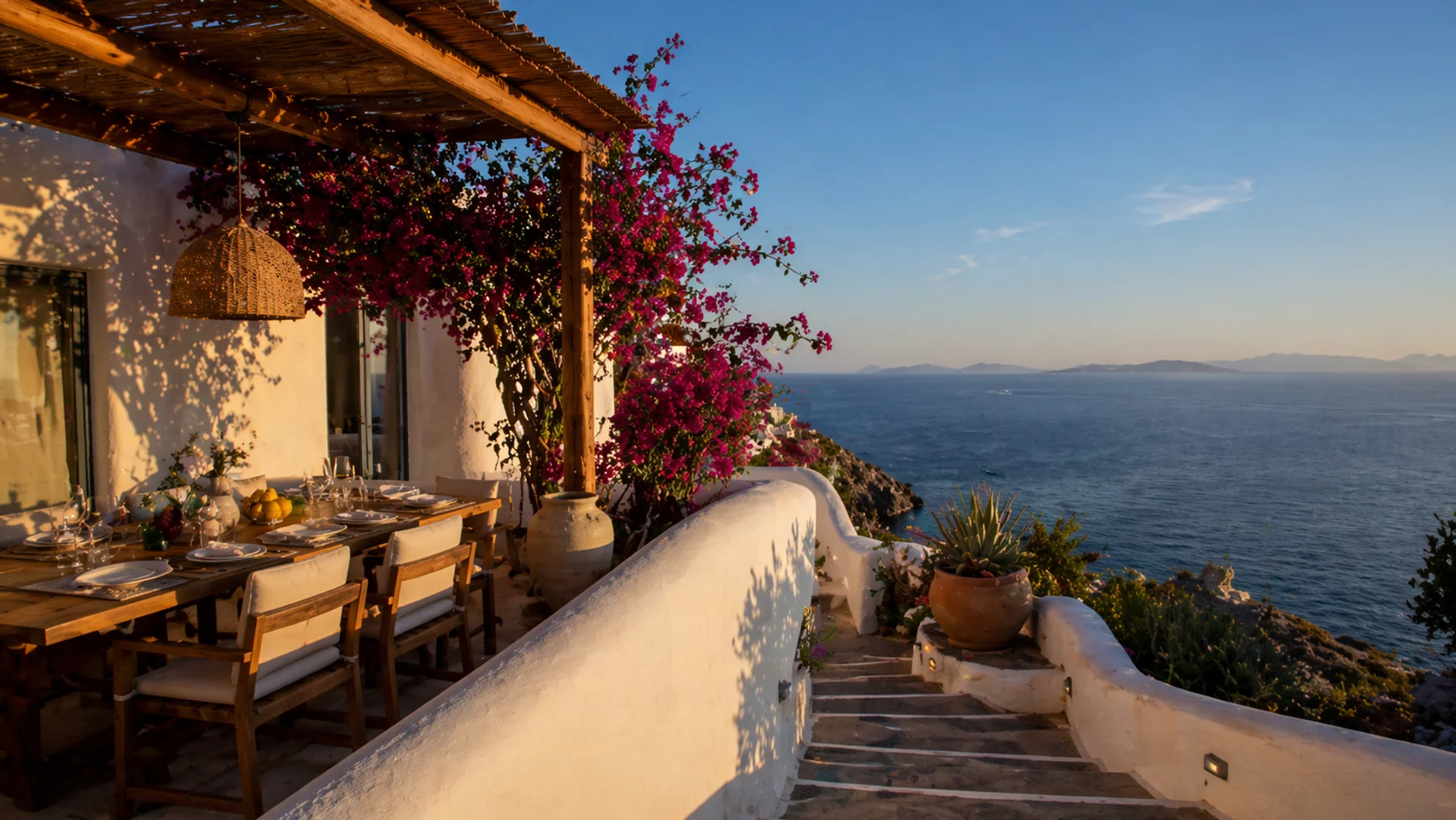
The visual case writes itself: Paras volcanic stone alongside bleached Cycladic whitewash, weathered teak against cobalt sea, natural rattan in a shaded terrace restaurant. What requires more explanation is the operational case, why ordering from Bali is preferable to sourcing from Italian or Spanish contract furniture manufacturers with shorter lead times and simpler logistics.
The answer is in the material quality and the level of customisation available. Italian contract furniture at comparable price points is typically factory-produced, with finish options, dimensions and configurations fixed by a catalogue. The workshop can produce a 320 cm dining table in reclaimed teak to within 5 mm of specification, carved with a specific edge profile, in a finish that matches a reference sample. For Mykonos villa owners and boutique hotel designers who are specifying bespoke interiors, that degree of customisation is decisive.
What a typical Mykonos hospitality project would include
Illustrative example. Mykonos hospitality projects typically fall into one of two categories. A boutique hotel commission in Hora or the surrounding hills (15 to 40 keys) would usually involve bedroom sets across all rooms, a restaurant or pool bar fit-out, and outdoor furniture for terraces facing the Aegean. A private rental villa in Elia, Kalo Livadi, or Agios Sostis (4 to 8 bedrooms) would typically include indoor and outdoor dining, lounge furniture, master and guest bedroom sets, and pool deck pieces. In both cases, a single 40ft container or two 20ft containers handles the full scope, and owners increasingly specify materials that hold up to close inspection by guests paying premium rates.
Furniture considerations for Mykonos climate
Anchor outdoor pieces against the meltemi. The dry summer wind reaches 7 to 8 Beaufort in July and August, and light aluminium or mass-market wicker does not hold position on exposed terraces. Specify heavy teak frames, stone-base dining tables, or pieces that can be physically anchored to the deck. Lightweight outdoor rattan should be reserved for sheltered courtyards.
Specify UV-stabilised finishes for any rattan or fibre work. Aegean UV peaks at 9 to 10 in July and August, untreated natural rattan typically bleaches within two seasons. For headboards, lounge chairs, and hanging chairs in semi-outdoor settings, UV coating is non-optional. Interior rattan in shaded rooms performs reliably without treatment.
Choose lacquered brass over raw iron for coastal hardware. Salt air at all coastal properties accelerates iron corrosion within a single season. Solid brass with clear lacquer typically holds finish for years. If the desired aesthetic is patinated, raw brass is fine, but the patina speed should be set as a brief decision, not discovered after delivery.
Buyer checklist for Mykonos projects
- Confirm street and access width before committing piece dimensions. Hora has stepped streets that no truck can enter, larger pieces require porter teams of three to four for the final 100 to 200 metres.
- Book a Mykonos port slot at least 4 weeks in advance for May to September deliveries. Peak-season congestion at the small commercial port can otherwise push delivery into the following ferry rotation.
- Plan a 2 to 3 day porter window for properties in Hora, particularly for staircase-access villas where pieces must be carried floor by floor.
- Greek customs at Piraeus is straightforward, but the inter-island ferry to Mykonos typically adds 4 to 5 hours after clearance. Factor this into any hard opening date.
- Verify in-town vehicle restrictions with the freight forwarder handling the final mile. Certain Hora streets carry permanent vehicle bans during summer, and a wrong assumption costs a full delivery day.
Questions
Frequently asked questions
How long does it take to get custom furniture from Bali to Mykonos?
Typically 12 to 20 weeks door to door depending on destination, including 8 to 10 weeks of production in the workshop in Bali. These are the workshop's typical lead times, not a commitment from Ubud Atelier. Containers from Benoa typically reach Piraeus in 22 to 28 days; the ferry to Mykonos typically adds 4 to 5 hours after clearance.
What import duty applies to wooden furniture in Mykonos?
Wooden furniture shipped to Mykonos, including seats with wooden frames, enters at 0% customs duty. Rattan and bamboo furniture carries 5.6%, cut to 0% for Indonesian origin under the EU GSP until December 31, 2026; Indonesia leaves the GSP on January 1, 2027. These are standard EU rates, set by HS classification.
Is VAT due on furniture imported into Mykonos, and at what rate?
Yes. Greece charges 24% import VAT on furniture shipped to Mykonos, calculated on the customs value plus duty plus transport to the place of destination in the EU. A VAT-registered business recovers the import VAT through its return. An indicative customs cost estimate can be prepared at quotation stage.
Which documents are needed to import furniture from Indonesia into Mykonos?
Wooden furniture for Mykonos needs a FLEGT licence, issued on the Indonesian SVLK timber legality system; rattan and bamboo pieces are outside the scheme. From December 30, 2026, the EU Deforestation Regulation also applies to wooden furniture: the operator placing it on the EU market files a due diligence statement with the geolocation of the plots where the wood grew.
Who handles shipping and customs clearance from Bali to Mykonos?
The workshop and its freight forwarder. The forwarder works with customs brokers at Piraeus, and goods continue by ferry from Rafina or Lavrio to Mykonos. HS classification is confirmed with the freight forwarder before each shipment leaves Bali. Ubud Atelier's role is to introduce the project to the workshop and relay information to the client.
Is solid teak suitable for a hotel or villa in Mykonos?
Yes. A-grade plantation teak suits Mykonos: its natural oils and silica resist moisture and salt air without chemical treatment. Left untreated it weathers to a silver-grey that sits naturally with Cycladic whitewash; annual teak oil keeps its golden tone. Outdoor rattan needs a UV coating.
What is the minimum project size for a hotel or villa in Mykonos?
Hospitality projects in Mykonos, from a boutique hotel in Hora to a rental villa in Elia, start from €25,000. A private residence, such as an owner's own villa, starts from €10,000.
How does furniture reach a villa on Mykonos once it is on the island?
Containers cannot reach many Mykonos properties on the island's narrow roads, so goods are transferred to smaller trucks for last-mile delivery, and stepped streets in Hora typically need porter teams. For May to September deliveries, a Mykonos port slot is typically booked at least 4 weeks in advance to avoid peak-season congestion.
Figures checked: September 2026
Have a project in Mykonos?
Share the scope, timeline and destination. Ubud Atelier comes back with the workshop's capacity and lead time within 48 hours.