Furniture · Outdoor
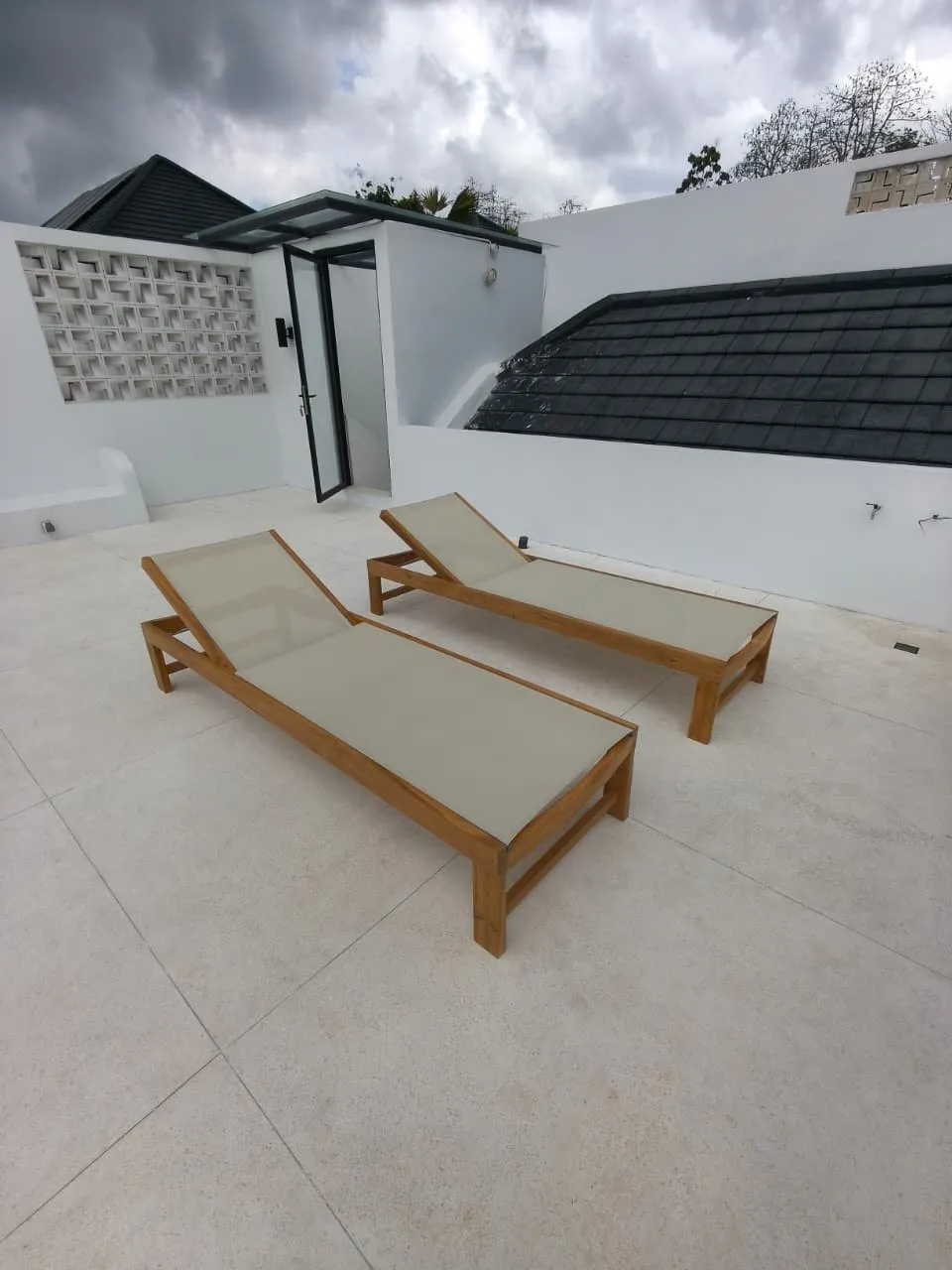
Outdoor loungers and pool furniture in A-grade teak
Teak pool furniture is the category where material grade decides how long the order lasts, because a sun lounger lives outdoors for its whole life with no shelter and no seasonal break. The workshop produces sun loungers, daybeds, poolside dining sets and the side tables that go with them in A-grade plantation teak, the grade selected for tight grain, high natural oil content and density above 650 kg per cubic metre. That density threshold is the point at which teak becomes genuinely weather-resistant rather than merely weather-tolerant. This page sets out the typical ranges, the cushion and finish options, and what the workshop needs in order to quote. Every piece is made to size.
Typical use
Hotel or resort
Pool deck and beach sets ordered as one specification so that every lounger on the property is identical and any later replacement matches what is already in service. Properties with more than one pool usually split the order by zone, with the same frame and a different cushion specification, so the two areas read as deliberate rather than mismatched.
Villa
A smaller poolside set for a private property: two to six loungers, a daybed, and an outdoor dining table with chairs. Ordered alongside the rest of a whole-house package this clears the private residence minimum comfortably, where the same set ordered alone would not.
Beach club
The heaviest duty case in this category, because the furniture is moved daily, sits in direct salt spray and is used by guests who did not buy it. Frames are drawn with that in mind, and castors or carry handles are specified where the set is repositioned every morning.
Specification
Typical ranges, all pieces made to size.
The figures below describe what the workshop typically works within. They are not a list of available formats and not a statement of capacity: every piece is cut to the dimensions on your drawings.
| Sun lounger | Typical length 1,900 to 2,100 mm, typical width 700 to 800 mm |
|---|---|
| Lounger seat height | Typical 350 to 420 mm from ground to seat frame |
| Backrest | Typical 4 to 5 fixed positions, brass ratchet or notched stay |
| Daybed, single | Typical 2,000 to 2,100 mm by 1,000 to 1,200 mm |
| Daybed, double | Typical 2,000 to 2,200 mm by 1,600 to 1,900 mm |
| Canopy | Optional four-post frame, typical clear height 1,900 to 2,100 mm |
| Poolside dining table | Typical 1,600 to 2,400 mm, seating 6 to 10 |
| Side table | Typical 400 to 550 mm square or round, typical height 400 to 500 mm |
| Slat spacing | Typical 8 to 12 mm, set for drainage rather than appearance |
| Mobility | Castors or carry handles specified where the set is moved daily |
Dimensioned schematic
Indicative only. The dimensions shown are typical ranges, not a drawing of a specific piece, and they do not describe a workshop capacity. Your own drawings govern.
From recent projects
Materials and finishes
The default and usually the only sensible choice for unsheltered outdoor use. FSC chain-of-custody documentation travels with the timber.
For covered positions only: terraces, shaded lounges, cabanas. A phytosanitary certificate may be required for natural fibre goods.
Ratchets, stays, castor mounts and fixings, specified for salt air.
Finishes
- Natural
- Left to weather to a silver-grey. The most common choice outdoors and the lowest maintenance.
- Oiled
- Holds the golden tone. Needs re-oiling on a schedule set by sun and salt exposure.
- Stained
- Available, though less common outdoors, where UV works against a stained tone over time.
Hardware
Solid brass for every moving and fixing component: backrest ratchets and stays, castor mounts, bolts and washers. Brass is specified because plated steel fails at the fixings first in salt air, and a lounger with a seized ratchet is out of service whatever condition the timber is in.
Order details
- Minimum order
- Quoted per project rather than per piece. Hospitality projects start from €25,000, typically one 20ft container, which a pool deck order for a mid-sized property normally reaches. Private residence projects start from €10,000.
- Lead time
- The workshop's typical production time is 8 to 10 weeks from the moment drawings and finishes are signed off. Door to door, the typical timing is 12 to 20 weeks depending on destination.
- Packing
- Each piece is wrapped in protective material and crated or blanket-wrapped for container loading. Packing, quality control before loading and the sea freight booking are the workshop's, through its freight forwarders. HS classification is confirmed with the freight forwarder before each shipment leaves Bali.
- To quote, the workshop needs
- Dimensioned drawings or a measured schedule, quantities by type, and the delivery country. An indicative customs cost estimate can be prepared at quotation stage once the destination is known.
Notes on specification
Outdoor furniture is the category where the destination belongs in the specification from the first sketch. UV index, humidity, salt load and how often the piece gets moved all change what the frame needs to be, and none of them can be corrected after the container arrives. A lounger drawn for a shaded Mediterranean terrace and a lounger drawn for an equatorial beach club are different pieces of furniture even when they look the same on a drawing.
Two things drive the cost. The first is timber volume, which on a lounger is mostly a function of frame section and slat count: a heavier frame lasts longer and costs more, and where the balance sits depends on whether the property is furnishing a guest area or a service area. The second is the moving parts. A fixed-back lounger is a simple piece; a five-position ratchet with brass stays is a mechanism, and mechanisms are where outdoor furniture either survives or fails.
Questions
Are cushions included in an outdoor furniture order?
Cushions are quoted separately and the fabric is sourced on request, because outdoor fabric is the part of the order most often already specified by the property's designer. Where there is no specification, the workshop can source an outdoor-grade fabric for approval. Where there is one, the fabric can be shipped to the workshop's Bali address and made up there, or the frames can ship bare for upholstery at destination.
Why A-grade teak rather than a cheaper grade for outdoor use?
Because outdoor furniture has no shelter and no off-season, and the difference between grades shows up in exactly those conditions. A-grade plantation teak is selected for tight uniform grain, high natural oil and density above 650 kg per cubic metre, which is what lets it resist moisture penetration without chemical treatment. A lower grade costs less per piece and needs replacing sooner, which on a hotel pool deck is the more expensive of the two outcomes.
How is outdoor furniture packed for sea freight?
Each piece is wrapped in protective material and crated or blanket-wrapped for container loading, with the crating drawn around the piece rather than the piece fitted into a standard box. Loading, packing and quality control before loading are the workshop's, as is the sea freight booking through its freight forwarders. The workshop's freight forwarder works with customs brokers at the destination port.
Can loungers be stacked or nested to save container space?
Stacking is possible on some frame designs and not on others, and it is worth raising early because it changes how many pieces fit in a container and therefore the shipping cost per piece. If container efficiency matters to the budget, say so at brief stage: the workshop can draw a frame that nests, rather than drawing the frame first and discovering the loading penalty at packing.
Start a project.
Send the drawings, the quantities and the delivery country. A reply follows within 48 hours by email.
Related services