Furniture · Joinery
Custom teak doors and windows from Bali
Custom teak doors and windows are the category where sourcing from Bali makes the most obvious sense, because joinery is measured work: nothing is bought off a shelf, so the cost of drawing and cutting to your openings is the same wherever the timber is worked. The workshop produces door leaves, frames, casement and sliding windows, and folding sets in A-grade plantation teak or reclaimed teak, to the sizes on your architect's schedule. This page sets out the typical ranges the workshop works within, the glazing and hardware options, and what the workshop needs in order to quote. All figures below are typical ranges, not fixed formats. Every piece is made to size.
Typical use
Hotel
Guest room and corridor door sets specified as one package, so leaf thickness, frame depth, hardware finish and the ironmongery schedule stay identical across every floor. Where a property needs a heavier specification at the entrance and a lighter one on interior rooms, the two are drawn as separate line items in the same order and loaded in the same container.
Villa
A full set of external and internal joinery for a single property: entrance doors, terrace sliding or folding sets, bedroom and bathroom doors, and the windows to match. This is the scope the private residence route was built for, because a whole-property joinery package fills enough of a container to carry its own shipping cost.
Restaurant or beach club
Folding and sliding sets used to open a dining room onto a terrace, plus service and back corridor doors in a heavier specification. Coastal positions drive the material and finish choice more than the dimensions do, which is why finish is specified against the destination rather than chosen from a catalogue.
Specification
Typical ranges, all pieces made to size.
The figures below describe what the workshop typically works within. They are not a list of available formats and not a statement of capacity: every piece is cut to the dimensions on your drawings.
| Single door leaf | Typical width 700 to 1,000 mm, typical height 2,100 to 2,700 mm |
|---|---|
| Double door set | Typical overall width 1,400 to 2,000 mm, two matched leaves |
| Sliding set | Typical 2 to 4 panels, typical panel width 800 to 1,200 mm |
| Folding set | Typical 3 to 6 leaves, typical leaf width 600 to 900 mm |
| Leaf thickness | Typical 40 to 60 mm, heavier where an entrance or acoustic spec calls for it |
| Frame depth | Typical 100 to 140 mm, set by the wall build-up on your drawings |
| Casement window | Typical width 600 to 1,200 mm, typical height 900 to 1,800 mm |
| Glazing options | Single glazed, double glazed, fixed louvre, or unglazed panel |
| Glazing supply | Glass sourced on request, or the set shipped unglazed for glazing at destination |
| Threshold and sill | Drawn to your floor build-up, drainage detail specified per opening |
Dimensioned schematic
Indicative only. The dimensions shown are typical ranges, not a drawing of a specific piece, and they do not describe a workshop capacity. Your own drawings govern.
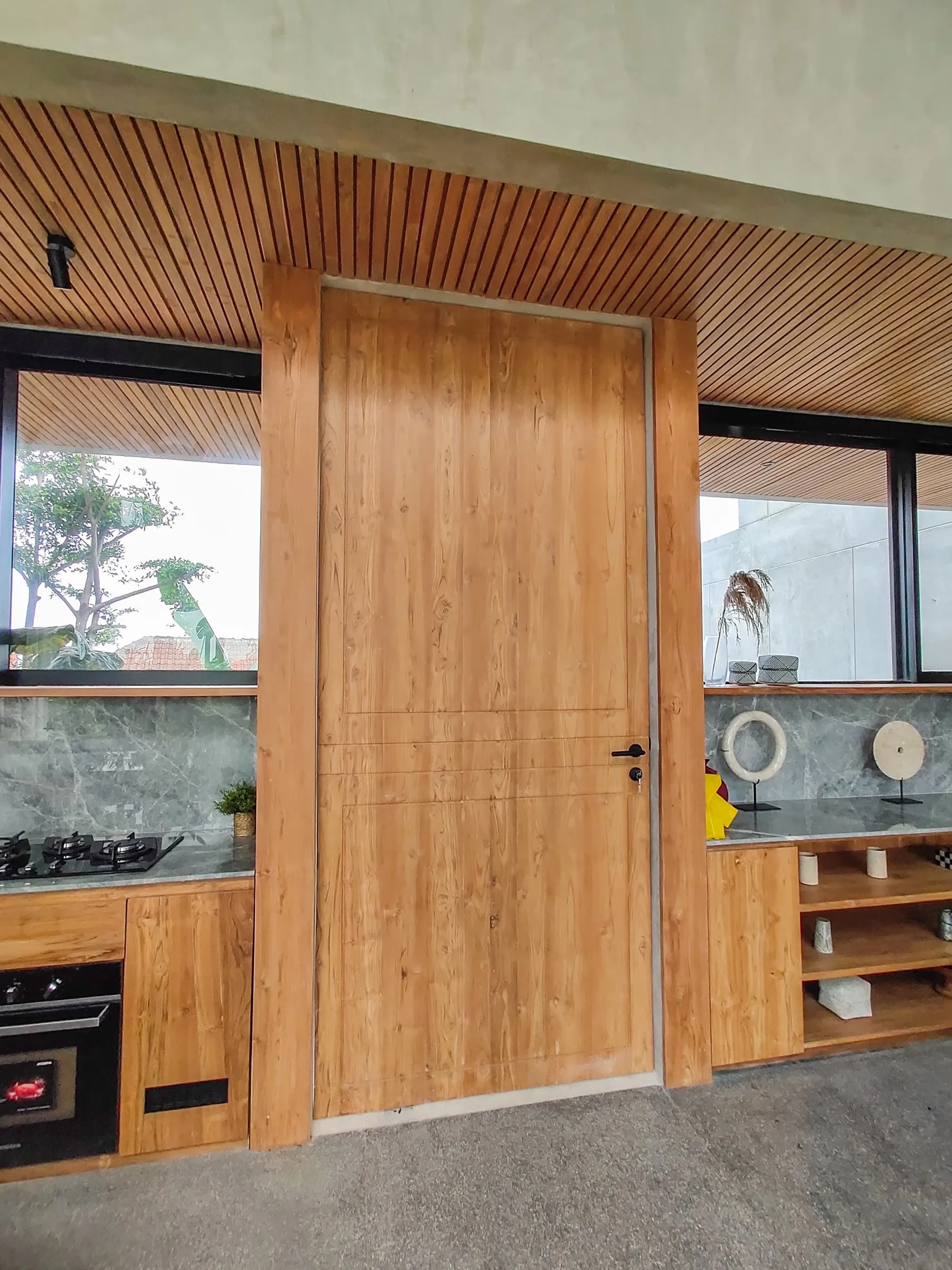
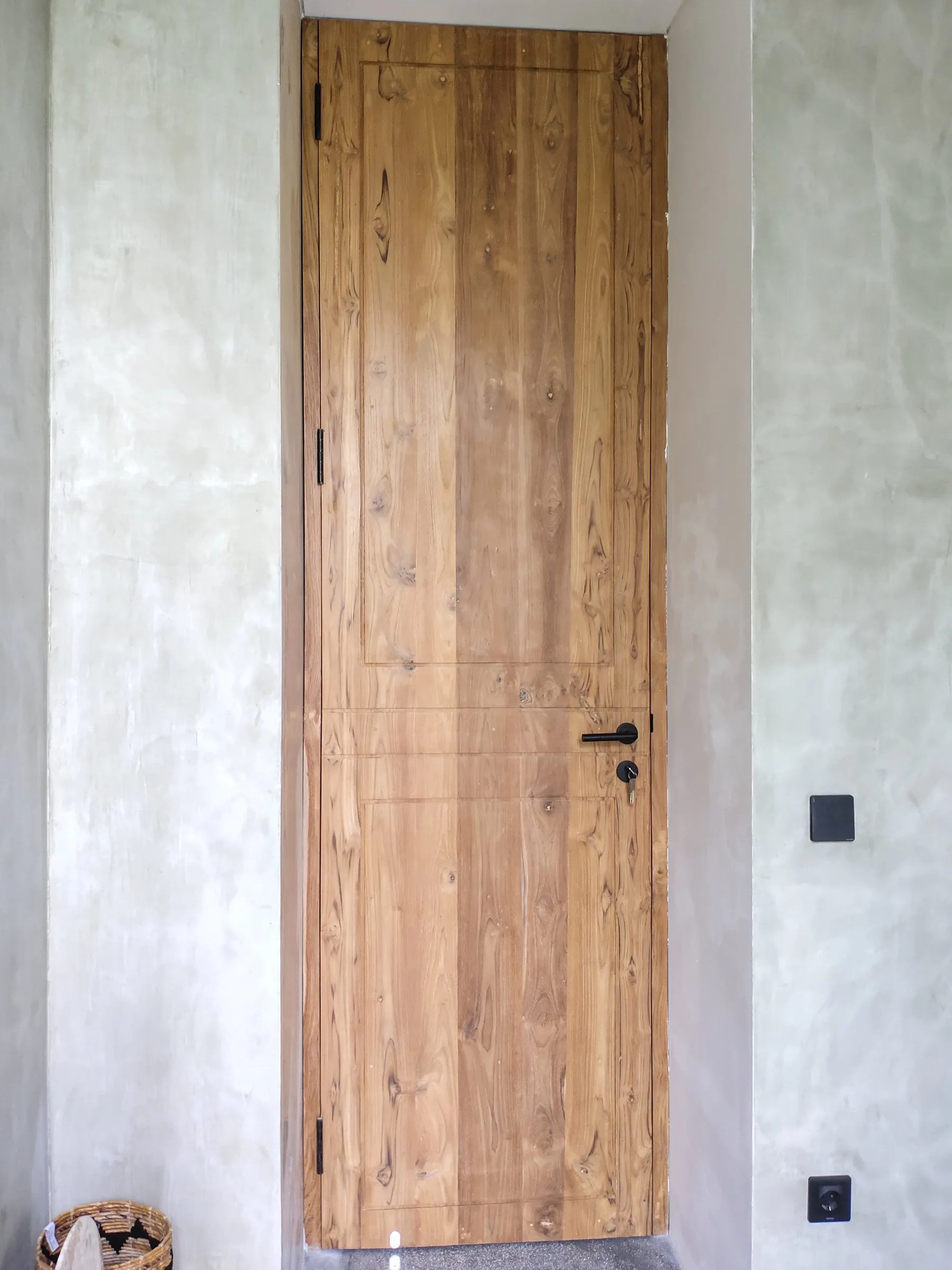
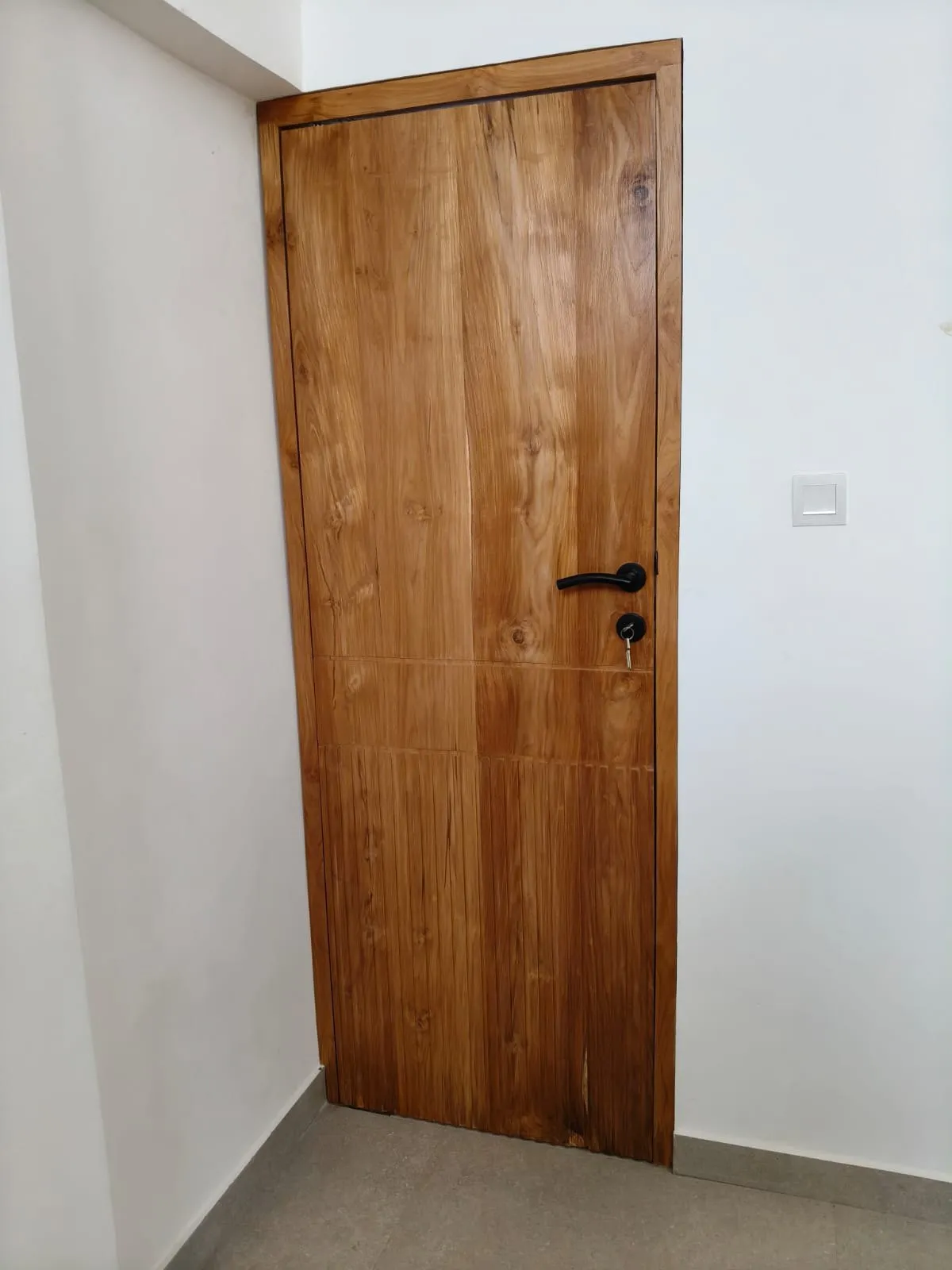
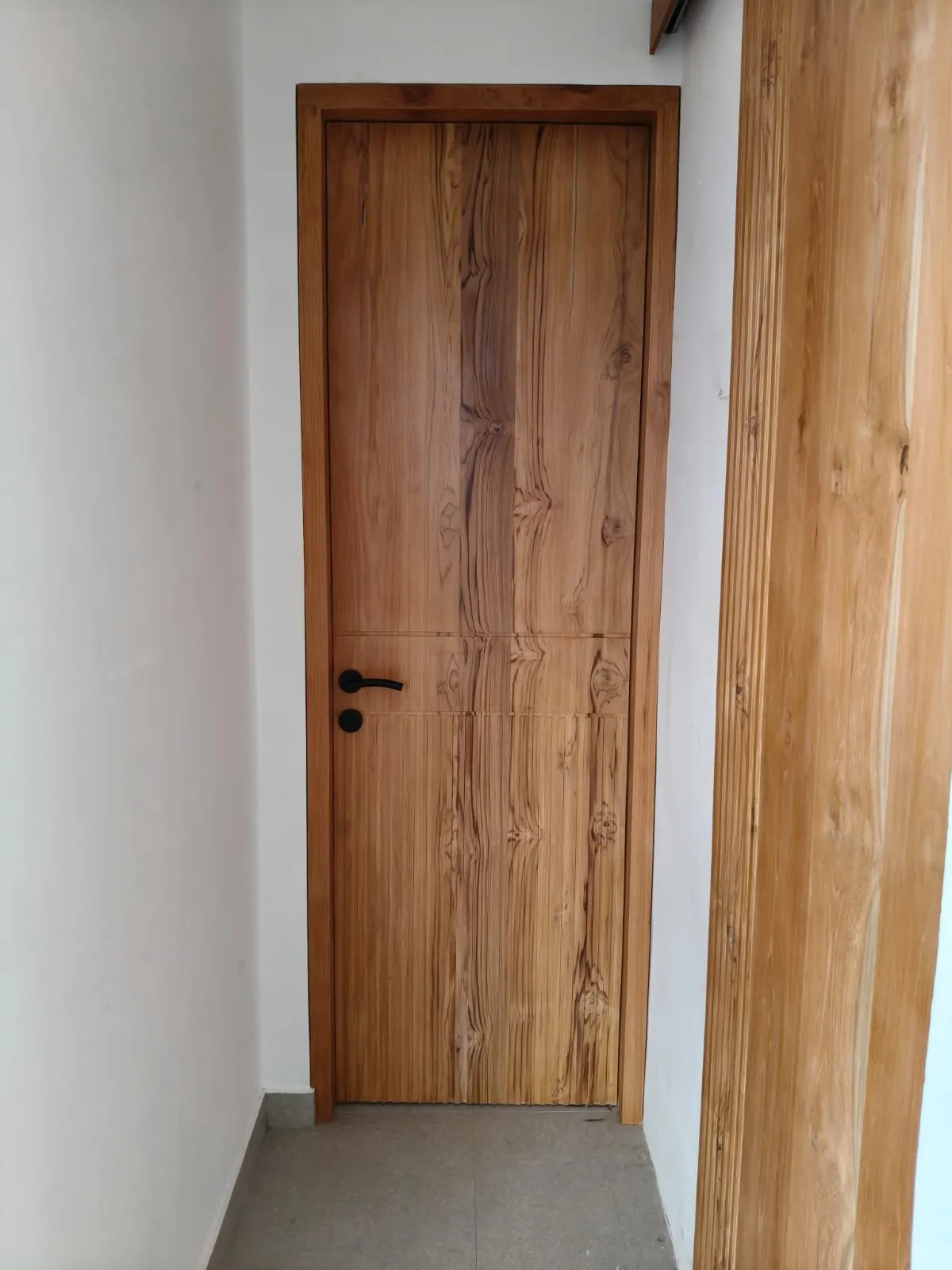
From recent projects
Materials and finishes
The default for external joinery. FSC chain-of-custody documentation travels with the timber.
Specified for character on entrance doors and feature openings. Zero-harvest declarations travel with the timber.
Finishes
- Oiled
- Retains the warm tone, needs re-oiling on a schedule set by exposure.
- Natural
- Left to weather. Silvers down over time without affecting the structure.
- Stained
- Tone matched to a sample you supply.
Hardware
Solid brass throughout: hinges, levers, locks, flush bolts, and the track and carriage sets for sliding and folding leaves. Brass is specified because it holds up in coastal air where plated steel does not. Finishes run from polished through brushed to darkened. Where a project has a specified ironmongery supplier, the workshop can fit client-supplied hardware instead, provided the schedule reaches the workshop before the leaves are machined.
Order details
- Minimum order
- Quoted per project rather than per piece. Hospitality projects start from €25,000, typically one 20ft container. Private residence projects start from €10,000, which a whole-property joinery package normally clears on its own.
- Lead time
- The workshop's typical production time is 8 to 10 weeks from the moment drawings and finishes are signed off. Door to door, the typical timing is 12 to 20 weeks depending on destination.
- Packing
- Each piece is wrapped in protective material and crated or blanket-wrapped for container loading. Packing, quality control before loading and the sea freight booking are the workshop's, through its freight forwarders. HS classification is confirmed with the freight forwarder before each shipment leaves Bali.
- To quote, the workshop needs
- Dimensioned drawings or a measured schedule, quantities by type, and the delivery country. An indicative customs cost estimate can be prepared at quotation stage once the destination is known.
Notes on specification
Joinery is quoted from drawings, so the quality of the drawing set determines the quality of the quotation. A schedule that lists each opening with its measured width and height, the handing, the wall build-up and the floor finish is enough for the workshop to price the whole package. A schedule that lists door types without dimensions is not, and the gap gets filled with assumptions that surface later as fit problems on site.
Two decisions move the cost more than anything else. The first is leaf thickness, because thickness drives timber volume and timber volume drives most of the price of a door. The second is glazing, because a double-glazed unit changes the leaf construction, the weight, the hardware and the crating all at once. Both are worth settling before the drawings are issued rather than during production.
Questions
Can the workshop produce doors to non-standard opening sizes?
Yes, and that is the normal case rather than the exception. Every leaf and frame is cut to the schedule on your drawings, so a non-standard opening carries no premium over a standard one. The ranges published on this page describe what the workshop typically works within, not a set of fixed formats. What matters is that the openings are measured on site and issued as a dimensioned schedule before production starts, because a leaf machined to the wrong figure cannot be corrected after the container is loaded.
Is the glass fitted in Bali or at the destination?
Either. Glass can be sourced on request and fitted before the set is crated, or the joinery can ship unglazed for glazing at destination. Shipping unglazed is common on long routes and for larger panels, because it removes the most breakable element from a sea voyage and lets the glazing specification follow local building requirements. The choice is made at quotation stage, since it changes both the crating and the weight.
What documentation travels with a teak joinery shipment?
The workshop supplies FSC chain-of-custody certificates for plantation teak, zero-harvest declarations for reclaimed teak, and SVLK Indonesian timber legality documentation. HS classification is confirmed with the freight forwarder before each shipment leaves Bali, and an indicative customs cost estimate can be prepared at quotation stage.
How does teak joinery behave in a dry or heated climate?
Teak moves with humidity like any solid timber, which is why the destination is part of the specification and not an afterthought. A set drawn for a humid coastal property and a set drawn for a heated interior in a Mediterranean winter carry different tolerances at the frame and different advice on finish. Tell the workshop where the joinery is going and it is drawn for that, rather than drawn generically and adjusted later.
Start a project.
Send the drawings, the quantities and the delivery country. A reply follows within 48 hours by email.
Related services
Shipping to