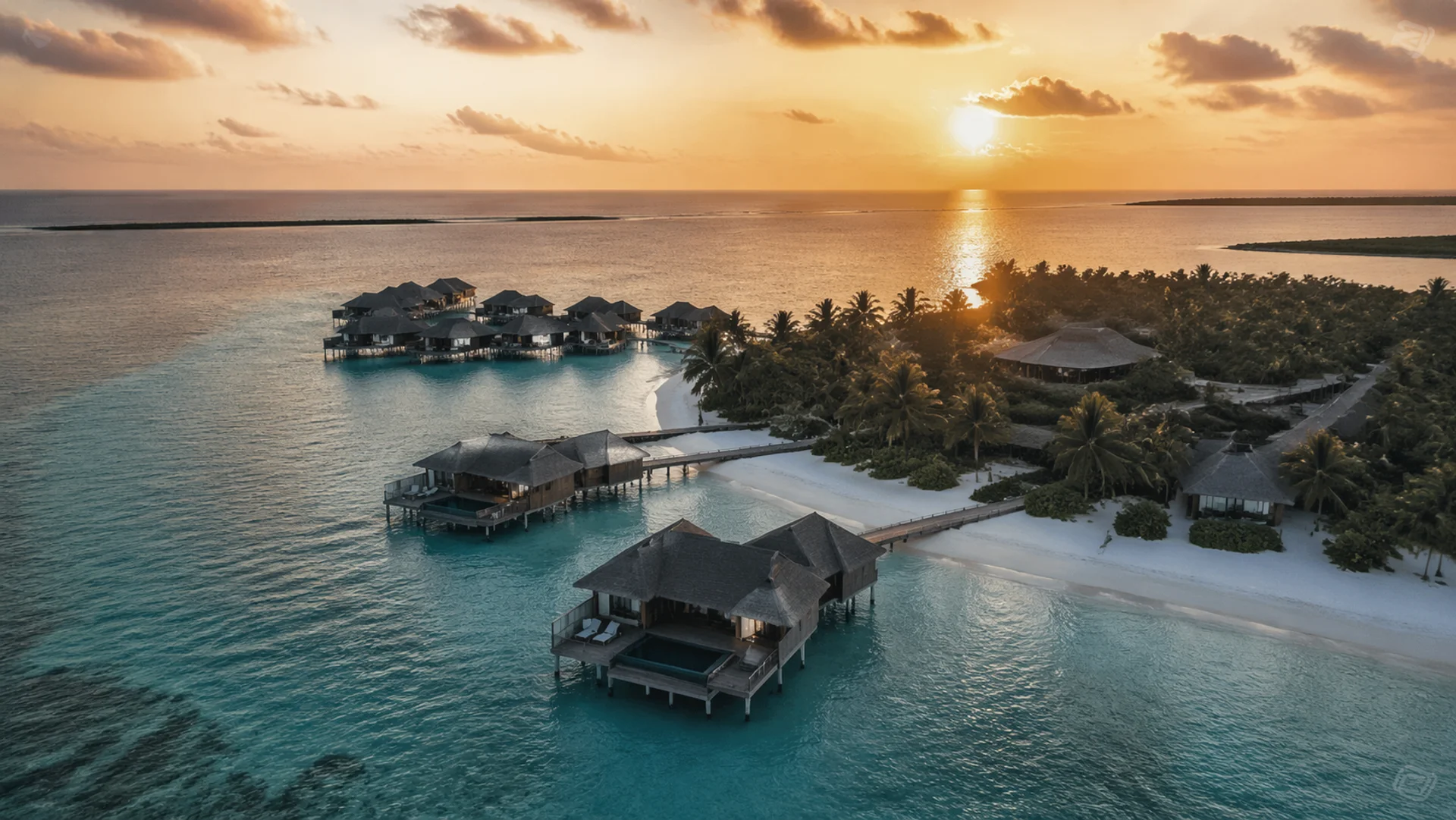
Maldives · Indian Ocean
Custom Bali Furniture for Maldives
Produced in the workshop in Kerobokan, Bali, and shipped door to door by the workshop and its freight forwarders. Typical ocean transit of 10 to 16 days.
Maldives, Indian Ocean
The market
The Maldives holds the highest concentration of luxury resort properties anywhere in the world, over 170 operational resorts across 26 atolls, with dozens more in development at any given time. The archipelago's physical format (each resort occupies its own island) creates a captive demand for high-quality furniture that can be delivered in full containers and withstand some of the world's most demanding coastal conditions: 90% average humidity, constant salt air, and UV intensity that degrades synthetic materials within 18 months. Bali is one of the few sources capable of meeting both the aesthetic expectations of five-star operators and the durability requirements of the marine environment.
Shipping & logistics
From Bali to Maldives, the practical details.
- Typical transit time
- 10 to 16 days
- Departure port
- Benoa, Bali
- Arrival port
- Port of Malé (MLE)
- Standard incoterms
- CIF Malé
- Furniture import duty
- 5% on furniture (HS 9401, 9403) under the Maldives National Tariff 2026; 20% on parts
- VAT / local tax
- No GST at import: GST (8% general, 17% tourism) is collected at the point of sale. A 1% revenue fee applies on the customs value
Transshipment via Colombo (Sri Lanka) or Singapore is standard. Direct weekly services are available from Benoa on some carrier networks. Final-mile delivery from Malé to resort island requires inter-island freight coordination, which the freight forwarder at Malé handles.
Customs & import notes
Furniture enters at 5% of CIF value on every HS 9401 and 9403 line of the Maldives National Tariff 2026 (parts 20%), plus a 1% revenue fee on the customs value and a small per-item declaration charge. GST is not levied at importation. Resort construction and upgrading projects may obtain discretionary import duty exemptions under section 40 of the Tourism Act, through the Ministry of Tourism; whether furniture qualifies is confirmed case by case. Documentation requirements: commercial invoice, packing list, certificate of origin (Indonesia), bill of lading. Indonesian timber leaves Bali under the SVLK timber legality system, Indonesia's export requirement for wood products.
Climate considerations
Tropical marine, extreme humidity, intense UV, permanent salt air. Furniture must be specified for salt-air resistance from day one.
- 90% average relative humidity year-round accelerates corrosion in ferrous metals
- UV index 11 to 12 (extreme) bleaches and degrades untreated rattan and bamboo within 12 to 18 months
- Salt air within 500m of open ocean requires marine-grade brass hardware and sealed timber
- Monsoon season (May to October) brings high rainfall, covered outdoor storage essential
Recommended materials for Maldives
A-Grade Teak
The only tropical hardwood with sufficient natural oil content to resist salt-air corrosion without chemical treatment. Specify 'marine-grade' finishing with penetrating teak oil. Weathers to a consistent silver-grey if left natural, visually appropriate for overwater and beach settings.
Natural Rattan (UV-coated)
Must be specified with UV-stabilising coating for Maldivian conditions. Without treatment, natural rattan degrades within 18 months outdoors. With treatment, typically suitable for shaded outdoor use for 8 to 12 years. Specify UV coating for every rattan piece in a Maldivian order.
Marine-Grade Brass Hardware
Standard brass alloy will develop green verdigris within 6 to 12 months in Maldivian salt air. Specify solid brass with clear lacquer sealant or marine-grade alloy (higher copper content). Matte black PVD coating is the most durable finish for coastal exposure.
Why Balinese furniture works for the Maldives
The Maldives and Bali share an aesthetic language built on the same raw materials, natural timber, woven fibre, volcanic stone, which makes Balinese craft a natural fit for Maldivian resort interiors. Beyond aesthetics, there is a practical logic: marine specification belongs in the brief from the start, a requirement that continental European or American suppliers often miss.
The critical difference is salt-air awareness. A chair built for a showroom in Milan or a restaurant in London is not built for placement on an overwater deck in the Indian Ocean. For Maldivian projects, each piece is worth reviewing against a marine environment checklist before production begins: hardware specifications, finish type, wood grain orientation for moisture resistance, and upholstery fabric weight and weave. These details are not cosmetic, they determine whether the furniture looks the same in year three as on the day it arrived.
Transit time from Bali to Malé is among the shortest of the destinations covered here. A container loaded in Benoa on a Monday typically arrives at Malé port within 14 days. That speed, combined with island delivery coordination handled by the freight forwarder, makes Bali one of the most operationally efficient furniture sources for Maldivian resort operators.
What a typical Maldives hospitality project would include
Illustrative example. A Maldives hospitality project would almost always be a resort commission (50 to 150 keys at the Four Seasons, Soneva, One&Only, Anantara, St Regis, or Cheval Blanc tier), since the country’s hospitality model is built around the one-island-one-resort format and standalone private villas are rare. Scope would typically span repeated bedroom FF&E across all keys (beach villas plus over-water bungalows, often with distinct specifications between the two), restaurant and bar interiors, spa fit-outs, and pool, beach, and jetty pieces. Project containers would commonly run to 2 to 4 × 40ft HC for full-property fit-outs, with over-water bungalow pieces often packed separately given their distinct marine spec. Atoll location, North Malé and South Malé for proximity, Baa and Lhaviyani for mid-range remote, Raa and Noonu for ultra-remote, materially shapes the inter-island transfer leg.
Furniture considerations for Maldives climate
Specify over-water bungalow pieces to a stricter marine grade than beach pieces. Over-water bungalow furniture lives in continuous salt spray, lagoon mist, and reflected UV exposure 24/7, conditions that exceed even beach-villa pressure on the same property. Marine-grade brass with PVD coating, fully sealed structural joinery, and dense old-growth or A-grade plantation teak are the practical defaults for over-water settings. Lighter or partially treated specifications acceptable on beach villas often fail within 18 to 24 months over-water.
Engineer for sustained 90% humidity with airflow-aware piece design. Maldivian humidity averages around 90% year-round, materially higher than most Caribbean and many Indian Ocean equivalents. Mold, mildew, and unsealed-joint failure are the practical consequences for unprepared interior pieces, particularly in air-conditioned keys where condensation cycles add stress. Slatted seat decks, ventilated cushion wells, and pre-shipping humidity acclimatisation are the durable spec; enclosed cushion wells without drainage are a recurring failure pattern.
Plan finishes against coral-sand abrasion and UV bleaching together. Maldivian beach properties contend with airborne coral sand that is significantly more abrasive than typical silica beach sand, and UV exposure runs at index 11 to 12 year-round. UV-stabilised finishes plus abrasion-tolerant surface treatments are a paired specification rather than two independent choices. Untreated rattan loses both colour and structural integrity within 12 to 18 months under combined exposure.
Buyer checklist for Maldives projects
- Target the November-to-April dry monsoon for major install windows. The May-to-October wet monsoon brings sustained rainfall and rougher inter-island sea conditions that slow speedboat and dhoni transfers materially.
- Confirm Malé clearance and atoll transfer modality with the workshop’s freight forwarder before container loading. Speedboat (proximity Malé), seaplane cargo (limited capacity), and barge or dhoni (volume freight to remote atolls like Baa, Raa, Lhaviyani, Noonu) each carry different scheduling and dimensional constraints.
- Differentiate the over-water bungalow and beach villa specifications in the brief, not at production. Over-water pieces have distinct hardware, joinery, and finish requirements that should be locked in before any common drawings are finalised.
- For remote atolls, factor 5 to 10 days of additional inter-island timing into hard opening dates, particularly during the wet monsoon.
- Verify Maldives Tourism Authority documentation eligibility with your customs broker before shipment. Resort development projects holding active permits may have access to specific clearance treatments, this is operationally relevant rather than something to assume.
- Coordinate jetty arrival dimensions with the resort’s marine transfer team. Final-mile from speedboat or dhoni to bungalow placement is constrained by jetty width and on-island walkway geometry.
Questions
Frequently asked questions
How long does it take to get custom furniture from Bali to the Maldives?
Typically 12 to 20 weeks door to door depending on destination, including 8 to 10 weeks of production in Bali. These are the workshop's typical lead times, not an Ubud Atelier commitment. Ocean transit to Malé typically takes 10 to 16 days via Colombo or Singapore, then an inter-island leg to the Maldivian resort.
What import duty applies to wooden furniture shipped from Bali to the Maldives?
The Maldives charges 5% customs duty on every HS 9401 and 9403 furniture line, and 20% on parts, on CIF value under the Maldives National Tariff 2026, with no preference for Indonesian origin. Resort projects may obtain discretionary duty exemptions under section 40 of the Tourism Act, confirmed case by case.
Is GST due on furniture imported into the Maldives?
No. The Maldives does not levy GST at importation; GST is collected at the point of sale, at 8% general and 17% tourism. A 1% revenue fee applies on the customs value, so duty and revenue fee together come to 6% of the customs value on furniture shipped from Bali.
Which documents are needed to import furniture from Indonesia into the Maldives?
Maldivian clearance at Malé requires a commercial invoice, a packing list, an Indonesian certificate of origin and the bill of lading. Wood products also need an SVLK timber legality certificate. HS classification is confirmed with the freight forwarder before each shipment leaves Bali.
Who takes care of shipping and customs clearance from Bali to the Maldives?
The workshop and its freight forwarder. The workshop's freight forwarder works with customs brokers at Malé, and HS classification is confirmed with the freight forwarder before each shipment leaves Bali. It also arranges the boat transfer to the Maldivian resort island. Ubud Atelier introduces the project to the workshop and relays information to the client.
Is solid teak suitable for an overwater resort in the Maldives?
Yes. A-grade teak's natural oils resist the Maldives' 90% humidity and constant salt air without chemical treatment. Left untreated it weathers to a consistent silver-grey; penetrating teak oil keeps its golden tone. UV-coated natural rattan is typically suitable for shaded outdoor use for 8 to 12 years; marine-grade brass suits the hardware.
What is the minimum project size for a resort or villa in the Maldives?
Hospitality projects in the Maldives, from a boutique island resort to an over-water villa programme, start from €25,000. A private residence, such as an owner's private island villa, starts from €10,000.
How long does delivery take to remote Maldivian atolls such as Baa or Raa?
Remote atolls such as Baa, Raa, Lhaviyani and Noonu typically add 5 to 10 days of inter-island timing after Malé, particularly during the May to October wet monsoon. Volume freight to these Maldivian atolls moves by barge or dhoni, arranged by the freight forwarder at Malé.
Figures checked: September 2026
Have a project in Maldives?
Share the scope, timeline and destination. Ubud Atelier comes back with the workshop's capacity and lead time within 48 hours.