Spain · Mediterranean
Custom Bali Furniture for Mallorca
Produced in the workshop in Kerobokan, Bali, and shipped door to door by the workshop and its freight forwarders. Typical ocean transit of 25 to 35 days.
Spain, Mediterranean
The market
Mallorca is the Balearic Islands' most established luxury market, spanning the southwestern coast (Port Andratx, Camp de Mar), the northwestern Tramuntana mountains (Deià, Sóller, Valldemossa), the northeastern coast (Pollença, Alcúdia), and Palma's increasingly refined urban hospitality. The island hosts approximately 50 luxury hotel properties (Belmond La Residencia in Deià, Cap Rocat, Castell Son Claret, Park Hyatt Mallorca, Jumeirah) and a substantial private villa market. Mallorca has experienced sustained luxury hospitality growth driven by its accessibility from European capitals, year-round operability, and the international ultra-high-net-worth ownership pattern (particularly German, British, Scandinavian, and increasingly North American buyers). The Tramuntana mountain villa segment (Deià, Sóller, Valldemossa) has expanded approximately 30% over the past decade.
Shipping & logistics
From Bali to Mallorca, the practical details.
- Typical transit time
- 25 to 35 days
- Departure port
- Benoa, Bali
- Arrival port
- Palma de Mallorca
- Standard incoterms
- CIF Palma
- Furniture import duty
- 0% on wooden furniture, including seats with wooden frames; 5.6% on rattan and bamboo, 0% for Indonesian origin under the EU GSP until December 31, 2026
- VAT / local tax
- 21% Spanish IVA applies on duty-inclusive value
Direct services from Benoa to Palma de Mallorca operate via Suez Canal routing through Barcelona or Valencia mainland, then short inter-island feeder to Palma (typically 1 day). Indicative total Bali-to-Palma transit is 26 to 36 days. Palma is Mallorca's primary container port and handles all major hospitality cargo. Final-mile road delivery to specific villa addresses (Deià, Sóller, Pollença) is straightforward, with most destinations reachable within 90 minutes of Palma. Tramuntana mountain access requires standard road delivery; no inter-island ferry needed unlike Aeolian Islands.
Customs & import notes
Spain operates as an EU member state, so EU customs procedures apply. Wooden furniture, including seats with wooden frames, enters the EU at 0% customs duty. Rattan and bamboo furniture carries 5.6%, cut to 0% for Indonesian origin under the EU GSP until December 31, 2026; Indonesia leaves the GSP on January 1, 2027. HS classification is confirmed with the freight forwarder before each shipment leaves Bali. The EU-Indonesia CEPA was concluded in September 2025 and is not yet signed; its entry into force is targeted for January 1, 2027. Standard 21% Spanish IVA, the Balearic Islands being inside the Spanish VAT territory, is charged at importation on the customs value plus duty plus transport to the place of destination in the EU; a VAT-registered business recovers it through its return, and monthly filers can settle it in the return. Wooden furniture from Indonesia needs a FLEGT licence, issued on the Indonesian SVLK timber legality system; rattan and bamboo pieces are outside the scheme. From December 30, 2026, the EU Deforestation Regulation also applies to wooden furniture: the operator placing it on the EU market files a due diligence statement with the geolocation of the plots where the wood grew. Spanish customs procedures align with mainland EU; the workshop's freight forwarder works with customs brokers at Palma.
Climate considerations
Mediterranean with hot dry summers (28 to 32°C) and mild winters (12 to 16°C). The Tramuntana mountains add a cooler, more humid microclimate to Deià and Sóller.
- Mediterranean, hot dry summers (28 to 32°C) and mild winters (12 to 16°C)
- UV index 9 to 10 in summer, 4 to 6 in winter
- Salt-air exposure on direct coast (Port Andratx, Cala Deià) is moderate
- Tramuntana mountain microclimate (Deià, Sóller) provides slightly cooler conditions and higher humidity from valley airflows
Recommended materials for Mallorca
A-Grade Plantation Teak (Mediterranean outdoor)
Teak is the primary outdoor material for Mallorca villas: pool decks, terrace dining, beach club furniture along the southwestern coast. Mallorca's intense summer UV (9 to 10 UV index in July to August) and mild salt air on coastal properties are handled by teak's natural oil content without chemical preservation. The Tramuntana mountain villas (Deià, Sóller) face less intense UV but more humidity from valley microclimates, also handled well by teak.
Reclaimed Teak (statement pieces)
Reclaimed teak's heritage character aligns with Mallorca's traditional finca aesthetic, where authentic age and material provenance are valued more than pristine newness. Statement dining tables, custom bar fronts, lobby feature walls for both private villas and boutique hotel renovation projects in Deià, Sóller, and Palma's urban segment.
Natural Rattan (covered outdoor & indoor)
Rattan suits Mallorcan covered terrace and indoor applications well. Lounge seating, partition screens, hanging chairs in shaded courtyards and ground-floor terraces. The traditional Mediterranean design language has historical use of natural fibres, complementing the local cane and bamboo crafts.
Why Balinese furniture works for Mallorca
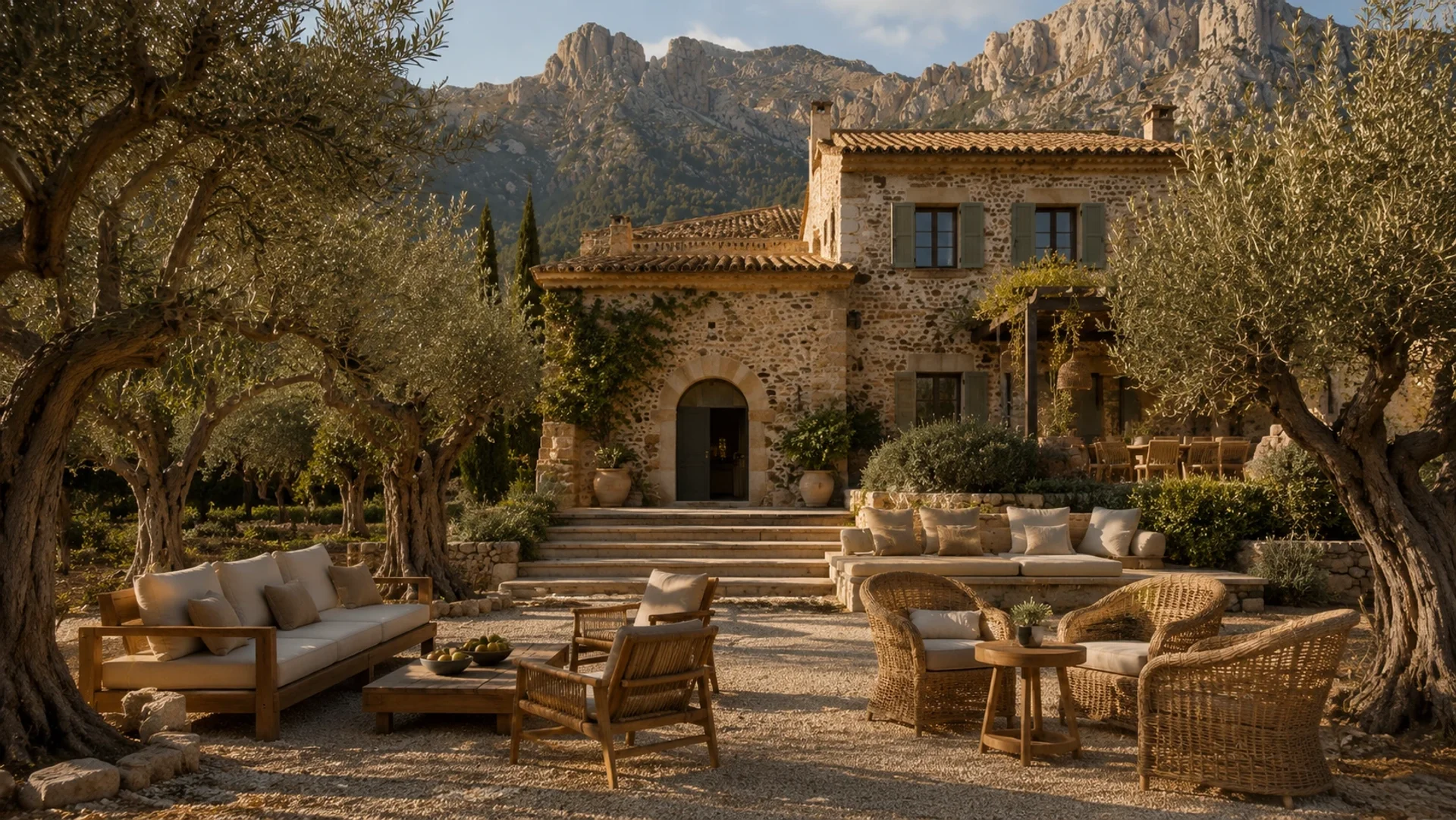
Mallorca’s luxury hospitality language draws from a distinct Balearic palette, local Mares sandstone and marès architecture, olive timber, finca-style stone and timber detailing, set against contemporary tropical-modern resorts and design-led hotels. Bali’s craft tradition speaks the contemporary register directly and aligns with the finca heritage palette through reclaimed teak, carved detail, and woven natural fibres at hospitality scale.
The operational case sits alongside the aesthetic. A Mallorcan hospitality project would typically need to coordinate Spanish contract furniture production (Andreu World, Expormim, Stua, mature but standardised) with very limited Balearic artisan supply. The Tramuntana mountain villa segment and the broader Mallorca luxury inventory have grown substantially over the past decade, putting pressure on local supply chains. A single Bali workshop with full-scope custom capability covers both contemporary and finca-aligned specifications under one production roof, with the piece-to-piece consistency that hospitality-grade procurement requires. On the customs side, total cost is essentially the local VAT only, since most solid wood furniture enters the EU at 0% duty.
What a typical Mallorca hospitality project would include
Illustrative example. A Mallorca hospitality project takes one of three shapes. A Tramuntana mountain commission in Deià, Sóller, or Valldemossa (often a converted finca or stone village house, 6 to 12 bedrooms) would typically include indoor dining and lounge, multiple bedroom sets, and weatherable terrace pieces sized for tight rural-road access. A Palma Old Town boutique hotel (30 to 60 keys) would involve full bedroom FF&E, restaurant fit-outs, and terrace or rooftop bar furniture. A coastal hotel commission in Cala d’Or, Pollença, or Port Andratx would prioritise outdoor entertaining furniture and pool-deck pieces alongside interior FF&E.
Furniture considerations for Mallorca climate
Match the finish palette to the property type. The agroturismo and Tramuntana finca aesthetic favours weathered, oiled, and reclaimed teak tones that pair with terracotta floors and stone walls, polished or high-sheen finishes feel out of place. Coastal Cala d’Or and Pollença properties accept a slightly broader palette, including cleaner-finished plantation teak. Set the finish direction during briefing, not after delivery.
Engineer for the Tramuntana microclimate, not the coastal default. Deià, Sóller, and Valldemossa sit 200 to 400 metres above sea level with 10 to 15% higher relative humidity than the southern coast and significantly cooler winter nights. Timber pieces destined for the mountains should be calibrated to the upper humidity range, and outdoor pieces in valley villas need finish protection against persistent winter dew.
Pair stone with weathered teak in Tramuntana houses. Traditional architecture is built on local stone (Mares sandstone, marès), and Paras volcanic stone basins, side tables, and low coffee pieces sit comfortably alongside it. The combination of weathered teak frames with stone tops or basins reads as authentic to the design tradition rather than imported tropical aesthetic.
Buyer checklist for Mallorca projects
- Book the Palma container slot 2 to 3 weeks in advance during the May to September peak. Palma is the only full-container port on the island, and slot pressure builds fast in summer.
- Confirm Tramuntana access dimensions before committing piece sizes. Sóller’s old town, Deià’s village core, and Valldemossa’s centre all have streets that cap at approximately 3 metres wide. Larger pieces need disassembly or alternative routing.
- For agroturismo properties, verify whether structural changes accompanying the furniture (built-in banquettes, banco de obra elements) require Consell Insular permits. These typically add 4 to 8 weeks.
- Add a 2 to 3 day buffer for May to September deliveries. High-season road traffic on the Ma-10 to the Tramuntana villages slows freight noticeably.
- Confirm with your installer whether Cala d’Or or Pollença beach-access deliveries need a small vehicle for the final 200 to 300 metres. Certain coastal access roads exclude commercial trucks during peak summer.
Questions
Frequently asked questions
How long does it take to get custom furniture from Bali to Mallorca?
The workshop's typical lead time is 12 to 20 weeks door to door depending on destination, including 8 to 10 weeks of production in Bali, never an Ubud Atelier commitment. Ocean freight runs via Suez to Barcelona or Valencia, then a short feeder to Palma, typically 1 day; indicative total transit from Benoa to Palma is 26 to 36 days.
What import duty applies to wooden furniture shipped from Bali to Mallorca?
Wooden furniture, including seats with wooden frames, enters Spain at 0% customs duty. Rattan and bamboo furniture carries 5.6%, cut to 0% for Indonesian origin under the EU GSP until December 31, 2026; Indonesia leaves the GSP on January 1, 2027.
Is VAT due on furniture imported into Mallorca, and at what rate?
Yes. Spanish IVA of 21% is charged at importation, Mallorca being inside the Spanish VAT territory, on the customs value plus duty plus transport to the place of destination in the EU. A VAT-registered business recovers it through its return, and monthly filers can settle it in the return.
Which documents are needed to import wooden furniture from Indonesia into Mallorca?
Wooden furniture for Mallorca needs a FLEGT licence, issued on the Indonesian SVLK timber legality system; rattan and bamboo pieces are outside the scheme. From December 30, 2026, the EU Deforestation Regulation also applies to wooden furniture: the operator placing it on the EU market files a due diligence statement with the geolocation of the plots where the wood grew.
Who handles shipping and customs clearance from Bali to Mallorca?
The workshop and its freight forwarder. The workshop's freight forwarder works with customs brokers at the destination port, Palma. HS classification is confirmed with the freight forwarder before each shipment leaves Bali, and an indicative customs cost estimate can be prepared at quotation stage. Ubud Atelier introduces the project to the workshop and relays information to the client.
Is solid teak suitable for a finca or villa in Mallorca?
Yes. A-grade plantation teak handles Mallorca's summer UV and mild coastal salt air: its natural oils and silica resist moisture without chemical treatment, and annual teak oil keeps the golden tone. Reclaimed teak suits traditional fincas, and natural rattan works on covered terraces and in shaded courtyards.
What is the minimum project size for a hotel or villa in Mallorca?
Hospitality projects in Mallorca, from a boutique hotel in Palma to a rural agroturismo, start from €25,000. A private residence, such as an owner's own finca, starts from €10,000.
How does furniture reach a villa in Mallorca's Tramuntana mountains?
By standard road delivery from Palma: Deià, Sóller and Pollença are typically within 90 minutes of the port, and no inter-island ferry is needed for Mallorca.
Figures checked: October 2026
Have a project in Mallorca?
Share the scope, timeline and destination. Ubud Atelier comes back with the workshop's capacity and lead time within 48 hours.